A Complete Beginner Guide to Tarot: How to Start Reading Cards
Tarot has fascinated seekers, mystics, and curious minds for centuries. Whether you’ve been drawn to the striking imagery on a friend’s deck, stumbled across tarot content online, or simply feel a pull toward something deeper, learning to read tarot cards is one of the most rewarding journeys you can undertake. It blends self-reflection, symbolism, storytelling, and intuition into a practice that can offer genuine clarity in moments of confusion and meaningful insight when life feels overwhelming.
This guide is designed for absolute beginners. You don’t need any prior experience with divination, astrology, or spiritual practices. You don’t need to be psychic. You don’t need to memorize seventy-eight card meanings before you touch a deck. What you need is curiosity, patience with yourself, and a willingness to sit with images and symbols until they start speaking to you. By the end of this article, you’ll understand how tarot works, how a deck is structured, how to choose your first deck, and how to perform your first readings with confidence. If you’re ready to start, you can also draw your card of the day right now for a taste of what tarot offers.
A Brief History of Tarot
The origins of tarot are more grounded than most people expect. Tarot cards were not created by ancient Egyptian priests or medieval sorcerers. They began as playing cards in 15th-century Italy, where wealthy families commissioned hand-painted decks for a trick-taking game called tarocchi. The earliest surviving decks, like the Visconti-Sforza from the 1440s, were luxury items — gilded, elaborate, and thoroughly secular.
The shift toward divination happened gradually. By the late 18th century, French occultists began associating tarot cards with mystical traditions. Antoine Court de Gebelin, a Swiss clergyman, published claims in 1781 that tarot encoded the wisdom of the ancient Egyptian god Thoth. While these claims had no historical basis, they ignited a tradition of esoteric interpretation that would shape tarot’s identity forever.
In the 19th century, French occultist Eliphas Levi linked tarot to the Kabbalah, the Hebrew Tree of Life, and the four elements of Western esotericism. This synthesis gave tarot a coherent symbolic framework that practitioners still use today. The Hermetic Order of the Golden Dawn, a British occult society active in the late 1800s, further systematized tarot’s esoteric associations, connecting each card to astrological signs, planets, and elemental dignities.
The most influential deck in modern tarot history is the Rider-Waite-Smith deck, published in 1909. Designed by Arthur Edward Waite with illustrations by Pamela Colman Smith, this deck broke from tradition by giving every card — including the numbered Minor Arcana — a fully illustrated scene. Previous decks had shown the Minor Arcana as simple pip cards (like playing cards showing just the suit symbols). By adding narrative imagery to every card, Smith made tarot accessible to anyone who could interpret a picture, regardless of whether they’d memorized traditional meanings.
Today, thousands of tarot decks exist, ranging from faithful Rider-Waite-Smith reinterpretations to radically original designs featuring cats, robots, queer iconography, and cultural traditions from around the world. The core structure, however, remains remarkably consistent across virtually all of them.
Understanding the Structure of a Tarot Deck
A standard tarot deck contains 78 cards, divided into two main sections: the Major Arcana (22 cards) and the Minor Arcana (56 cards). Understanding this division is the single most important structural concept in tarot.
The Major Arcana: Life’s Big Themes
The 22 Major Arcana cards represent major life themes, archetypal energies, and transformative experiences. They are numbered 0 through 21, beginning with The Fool and ending with The World. When a Major Arcana card appears in a reading, it signals something significant — a karmic lesson, a major life transition, a deep psychological pattern, or a force that feels larger than everyday circumstances.
The Major Arcana tells a story known as The Fool’s Journey, which traces the evolution of a soul from innocent potential (The Fool) through various stages of growth, challenge, and illumination, culminating in wholeness and completion (The World). This narrative arc provides a powerful framework for understanding each card’s place in the broader human experience. For a deeper look at each of these powerful cards, explore our full guide to the Major Arcana and their meanings.
Key Major Arcana cards include The Magician (willpower and manifestation), The High Priestess (intuition and mystery), The Empress (abundance and nurture), The Emperor (structure and authority), The Wheel of Fortune (cycles and fate), Death (transformation and endings), The Tower (sudden upheaval), and The Star (hope and healing).
The Minor Arcana: Daily Life and Practical Matters
The 56 Minor Arcana cards address the situations, emotions, challenges, and interactions of everyday life. They are divided into four suits, each containing 14 cards: Ace through 10, plus four Court Cards (Page, Knight, Queen, and King). To learn each suit and number in detail, see our guide to the Minor Arcana suits and court cards.
- Wands (Fire) — creativity, passion, ambition, energy, willpower, and action. Wands represent what drives you, what excites you, and where your creative fire burns. Astrologically linked to Aries, Leo, and Sagittarius.
- Cups (Water) — emotions, relationships, love, intuition, dreams, and the inner life. Cups deal with matters of the heart, emotional patterns, and connections with others. Astrologically linked to Cancer, Scorpio, and Pisces.
- Swords (Air) — thoughts, communication, conflict, truth, decisions, and mental processes. Swords represent the mind’s power and its pitfalls — clarity and confusion, truth and deception. Astrologically linked to Gemini, Libra, and Aquarius.
- Pentacles (Earth) — money, career, health, material security, nature, and the physical world. Pentacles address the tangible aspects of life — what you build, earn, and sustain. Astrologically linked to Taurus, Virgo, and Capricorn.
Each number within the suits carries its own energy. Aces represent new beginnings and raw potential. Twos involve choices and duality. Threes indicate growth and collaboration. Fours bring stability and structure. Fives introduce conflict and challenge. Sixes offer harmony and resolution. Sevens present tests of faith and perseverance. Eights signify movement and mastery. Nines approach culmination and near-completion. Tens represent endings, fulfillment, and the transition to a new cycle.
The Court Cards
Court Cards are often the trickiest part of tarot for beginners. Each suit has four: the Page, Knight, Queen, and King. These can represent actual people in your life, aspects of your own personality, or stages of development within the suit’s domain.
- Pages represent youthful energy, curiosity, messages, and new learning in the suit’s area.
- Knights represent action, pursuit, movement, and sometimes excess in the suit’s domain.
- Queens represent mastery of the suit’s inner qualities — emotional intelligence, creative maturity, intellectual depth, or practical wisdom.
- Kings represent outward mastery and authority in the suit’s domain — leadership, command, and the ability to direct the suit’s energy in the world.
How to Choose Your First Tarot Deck
Choosing a first deck can feel overwhelming given the thousands of options available. Here are practical guidelines to simplify the process.
Start with the Rider-Waite-Smith or a Close Derivative
The Rider-Waite-Smith (RWS) deck is the most widely taught, written about, and referenced tarot deck in the English-speaking world. Nearly every beginner book, online course, and tutorial uses RWS imagery. Starting here means you can learn from virtually any tarot resource. Many beautiful modern decks — the Modern Witch Tarot, the Light Seer’s Tarot, the Everyday Tarot — follow RWS symbolism closely while updating the aesthetic.
Choose Fully Illustrated Pip Cards
Some decks (especially Marseilles-style decks) show the Minor Arcana as simple patterns — the Three of Cups shows three cups, period. For beginners, decks with fully illustrated scenes on every card are far easier to read intuitively. You can look at the image and extract meaning even before you’ve memorized the traditional interpretation.
Pick Art That Resonates With You
You’ll be staring at these images for hundreds of hours. If the art doesn’t move you, your practice will suffer. Visit a bookstore and flip through decks in person, or browse deck reviews online. When a deck’s imagery makes you pause, makes you feel something, or sparks your curiosity, that’s a strong sign it’s right for you.
Ignore the “Gifting” Myth
There’s a persistent superstition that your first deck must be gifted to you. This is not true. It has no historical basis and no practical value. Buy yourself a deck whenever you feel called to do so. Your connection to tarot begins with your intention, not with the transaction method.
Don’t Overthink It
Your first deck doesn’t need to be your forever deck. Many experienced readers own five, ten, or twenty decks. Your first deck is a learning tool, not a lifelong commitment. Choose something accessible, affordable, and visually appealing, and begin.
Preparing for Your First Reading
Before you lay out a single card, a few preparatory steps will make your readings clearer and more meaningful.
Create a Quiet Space
Tarot reading works best when you can focus without distraction. You don’t need an altar, candles, or crystals (though many readers enjoy these elements). You do need a clean surface, a few minutes of quiet, and the mental willingness to be present with the cards. Turn off your phone or at least put it on silent. Sit comfortably. Take three slow breaths.
Formulate a Clear Question
The quality of your reading depends heavily on the quality of your question. Vague questions produce vague answers. Instead of “What about my love life?”, try “What do I need to understand about my current romantic situation?” Instead of “Will I get the job?”, try “What energy should I bring to my job search this month?”
Open-ended questions (starting with “what,” “how,” or “why”) generally produce richer readings than yes/no questions, especially for beginners. As you gain experience, you’ll develop a sense for which question types work best with your style.
Shuffling the Deck
There is no single correct way to shuffle tarot cards. Common methods include:
- Overhand shuffle — the most common method, works well with standard-sized decks.
- Riffle shuffle — effective but can damage cards over time if done aggressively.
- Pile shuffle — divide the deck into several small piles and recombine in a new order.
- Washing/smooshing — spread all cards face-down on the table and mix them around with both hands. This method is excellent for getting reversed (upside-down) cards into the mix naturally.
Shuffle until you feel ready to stop. Some readers shuffle until a card falls out (a “jumper”), which they read as an additional message. Others shuffle a set number of times. Trust your own sense of when the deck feels “ready.” Cut the deck into three piles and restack them if that feels right, or simply draw from the top.
Essential Tarot Spreads for Beginners
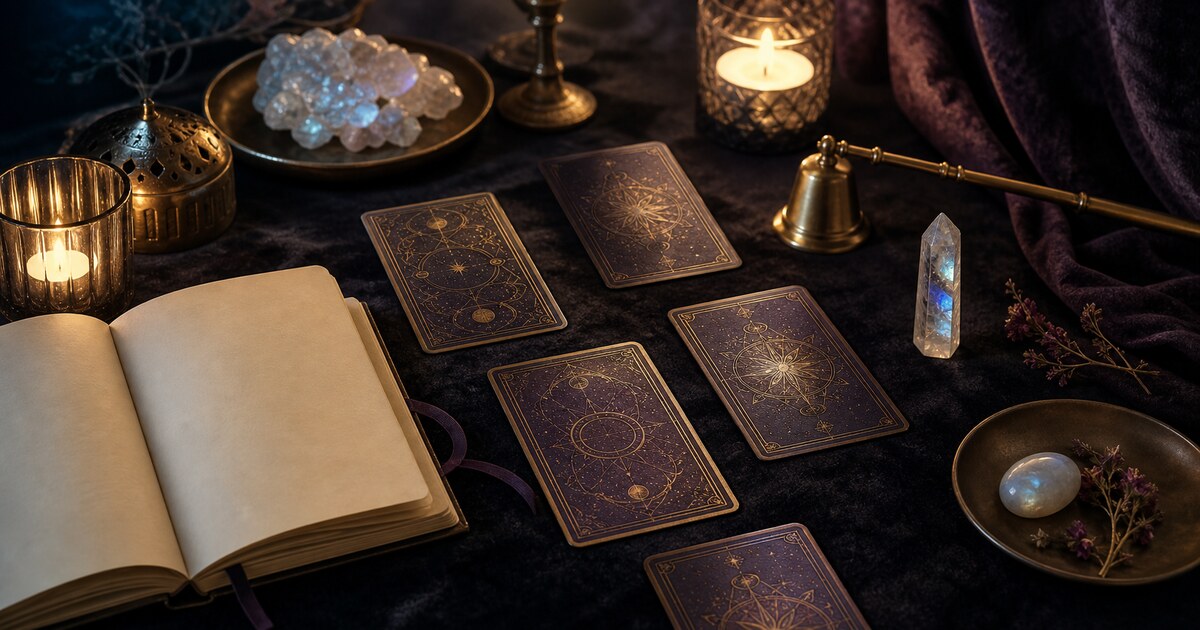
A tarot spread is a predetermined layout that assigns a specific meaning to each card position. Learning a few key spreads will give you structure while you build your reading skills.
One-Card Daily Draw
This is the single best practice for learning tarot. Each morning (or evening), draw a single card and reflect on its message for the day. Keep a tarot journal and write down which card you drew, what you think it means, and — at the end of the day — how it actually related to your experience. Over weeks and months, this practice builds an intimate, personal relationship with every card in the deck. Try your first daily card draw now.
Three-Card Spread
The three-card spread is the most versatile beginner layout. Draw three cards and place them in a row, left to right. The most common frameworks for the three positions are:
- Past — Present — Future: What brought you here, where you stand now, and what’s coming.
- Situation — Challenge — Advice: The current situation, the obstacle you face, and guidance for moving forward.
- Mind — Body — Spirit: Your mental state, physical situation, and spiritual needs.
- You — The Other Person — The Relationship: Useful for relationship questions or love readings.
Decide on your framework before you draw. The cards’ meanings shift based on the position they occupy, and changing the framework after drawing leads to muddled interpretations.
The Celtic Cross
The Celtic Cross is the most famous tarot spread, using ten cards arranged in a cross-and-staff pattern. While it’s a powerful spread, it can be overwhelming for true beginners because it requires reading ten cards in relation to each other. We recommend mastering the one-card and three-card spreads first, then graduating to the Celtic Cross once you feel confident reading cards in context.
The ten positions in the Celtic Cross typically cover: the present situation, the crossing challenge, the unconscious foundation, the recent past, possible future, immediate future, your attitude, external influences, hopes or fears, and the final outcome. For a wider exploration of different layouts, see our guide to tarot spreads.
The Five-Card Cross
A useful intermediate spread. Draw five cards and place them in a cross pattern: one in the center (the present), one above (the aspiration or best outcome), one below (the foundation or unconscious influence), one to the left (the past), and one to the right (the future). This provides more depth than three cards without the complexity of ten.
How to Interpret Tarot Cards
Interpretation is where the real art of tarot lives. There are two broad approaches, and the best readers use both.
Intuitive Reading
Before consulting any book or memorized meaning, look at the card. Really look at it. Notice the colors, the figures, the landscape, the objects, the expressions, the weather, the direction people are facing. Ask yourself: What do I feel when I look at this image? What story does this picture tell? What detail catches my eye first? That first impression is your intuition speaking, and it often contains the most personally relevant message.
Intuitive reading is especially powerful because the same card can carry different emphases depending on the question, the position, and the reader’s state of mind. The traditional meaning of the Three of Swords is heartbreak and emotional pain. But if your eye is drawn to the rain clearing in the background of the Rider-Waite-Smith version, the card might be telling you that the worst is over and healing has already begun.
Traditional Meanings
Every card has a body of traditional meanings built up over centuries of practice. These provide a foundation for interpretation, especially when your intuition is quiet or when you’re learning a new card. A good tarot book or reference app can give you keywords, traditional interpretations, and symbolic associations for each card.
The key is to treat traditional meanings as a starting point, not a rigid rule. If a book says the Nine of Pentacles means “financial independence and luxury,” but the card appears in a reading about your mother’s health, you might interpret it as self-sufficiency in caregiving, the financial cost of medical care, or the need to cultivate your own well-being while supporting someone else. Context always modifies meaning.
Reversed Cards
When a card appears upside-down in a reading, it is called “reversed.” Reading with reversals is optional — some experienced readers don’t use them at all. But if you choose to include reversals, they typically indicate:
- The card’s energy is blocked, delayed, or internalized.
- The shadow side of the card’s meaning is active.
- The card’s energy is diminished — present but weaker than it would be upright.
- A need to reconsider or revisit the card’s theme before moving forward.
Beginners may find it helpful to read without reversals at first. Once you have a solid grasp of each card’s upright meaning, adding reversals introduces nuance and depth to your readings.
Reading Cards in Combination
Individual card meanings matter, but the real richness of tarot emerges when you read cards in relation to each other. Two cards side by side create a narrative. Three cards tell a story with a beginning, middle, and end. A full spread weaves multiple threads into a tapestry of meaning.
When reading combinations, look for:
- Repeated suits — three Cups in a spread emphasizes emotional matters; multiple Swords point to mental activity or conflict.
- Repeated numbers — two Aces suggest multiple new beginnings; three Fives indicate a period of widespread challenge.
- Visual connections — in the Rider-Waite-Smith deck, some cards’ figures seem to look at or away from adjacent cards. This can suggest attention, avoidance, or relationship dynamics.
- Elemental interactions — Fire (Wands) and Air (Swords) support each other, as do Water (Cups) and Earth (Pentacles). Fire and Water can indicate steam — passion meeting emotion, conflict or creative tension.
- Major vs. Minor Arcana balance — a spread dominated by Major Arcana suggests a period of major life significance. A spread of all Minor Arcana points to practical, everyday matters.
Intuition vs. Memorization: Finding Your Balance
One of the most common debates in the tarot community is whether you should memorize card meanings or rely on intuition. The honest answer is: both, in a balance that evolves as you grow.
In the beginning, you’ll rely heavily on guidebooks and memorized keywords. This is completely normal and nothing to feel ashamed about. Every fluent tarot reader started by looking up card meanings. The difference between a beginner and an experienced reader isn’t that one uses books and the other doesn’t — it’s that the experienced reader has internalized thousands of readings’ worth of context, so the meanings flow naturally.
As you practice, your intuition will strengthen. You’ll start noticing details in the imagery that no book mentioned. You’ll feel visceral reactions to certain cards. You’ll “know” what a card means in a specific context before your conscious mind catches up. This is intuition developing through experience, not replacing knowledge but building upon it.
The ideal approach for beginners is: look at the card first, feel whatever you feel, and then check the traditional meaning. Over time, the gap between your intuitive impression and the traditional meaning will narrow. Eventually, they’ll inform each other seamlessly.
Common Beginner Mistakes and How to Avoid Them
Every tarot reader makes mistakes in the beginning. Here are the most common ones and how to sidestep them.
Asking the Same Question Repeatedly
If you don’t like the answer you get, it’s tempting to shuffle and draw again. Resist this urge. Repeatedly asking the same question doesn’t clarify the answer — it muddies it. The first draw is your reading. If you’re confused by it, sit with it, journal about it, or come back to it the next day. Don’t redraw until the message has had time to reveal itself.
Fearing “Negative” Cards
Death, The Tower, the Ten of Swords — these cards look frightening, and beginners often panic when they appear. But no tarot card is inherently “bad.” Death represents transformation and the clearing away of what no longer serves you. The Tower demolishes false structures so something authentic can be built. The Ten of Swords, while painful, marks the absolute end of a difficult cycle — things can only improve from here.
Approach every card with curiosity rather than fear. Ask “What is this card trying to teach me?” rather than “What terrible thing is going to happen?”
Over-Relying on Yes/No Interpretations
Tarot is not a Magic 8-Ball. While you can use it for yes/no questions, its real power lies in nuanced guidance. “Should I take the job?” is less useful than “What do I need to consider about this career opportunity?” The former gives you a binary answer; the latter gives you wisdom you can actually apply.
Reading for Others Too Soon
The desire to read for friends and family is understandable, but jumping to public readings before you’re comfortable with the cards can shake your confidence. Spend at least a few months doing daily draws and personal readings before offering to read for others. You need to build a relationship with your deck and trust your interpretive abilities.
Trying to Memorize Everything at Once
Seventy-eight cards, upright and reversed, across multiple life areas — that’s potentially hundreds of meanings. Don’t try to memorize them all before you start reading. Learn the card as you draw it. Over the course of regular daily draws, you’ll encounter and learn every card naturally within a few months. This organic learning is far more effective than rote memorization.
Neglecting the Question
A reading without a clear question is like a conversation without a topic — it wanders. Always formulate a question before you draw, even for a daily card pull. Something as simple as “What energy should I be aware of today?” gives the reading direction and makes interpretation easier.
The Ethics of Tarot Reading
As you develop your tarot practice, ethical considerations become increasingly important, especially if you begin reading for other people.
Consent and Boundaries
Never read for someone who hasn’t asked. It’s tempting to do a reading about your ex, your boss, or your neighbor, but reading about someone without their knowledge or consent crosses an ethical line. Focus your readings on yourself and the people who voluntarily seek your guidance.
Health, Legal, and Financial Advice
Tarot readers are not doctors, lawyers, or financial advisors. If a reading raises concerns about someone’s health, legal situation, or finances, the ethical response is to encourage them to consult a qualified professional. Phrases like “the cards suggest you might benefit from speaking with a therapist” are appropriate. Diagnosing, prescribing, or predicting specific medical outcomes is not.
Vulnerability and Responsibility
People often seek tarot readings during vulnerable moments — after breakups, during illness, when facing major decisions. A responsible reader recognizes this vulnerability and treats it with care. Never use fear to manipulate or to sell additional readings. Never present tarot as infallible prophecy. Always empower the querent (the person receiving the reading) by emphasizing their agency and choices.
Accuracy and Honesty
If you don’t understand a card in context, say so. “I’m not sure what this card means in this position — let me think about it” is far more ethical than making something up. Intellectual honesty builds trust and, paradoxically, strengthens your readings. Admitting uncertainty forces you to look deeper, and that deeper look often produces the most meaningful insights.
Predictive vs. Reflective Reading
There are two broad philosophical approaches to tarot. Predictive reading treats tarot as a tool for seeing the future. Reflective reading treats tarot as a mirror for understanding the present and exploring possibilities. Most modern practitioners lean toward the reflective approach, viewing tarot as a tool for self-awareness and decision-making rather than fortune-telling. This framing is not only more ethically sound — it’s also more psychologically useful and practically valuable.
Building a Consistent Practice
The single most important factor in becoming a confident tarot reader is consistent practice. Here’s how to build a sustainable routine.
Daily Card Draws
Pull one card every morning. Before looking up its meaning, spend thirty seconds studying the image. Write down your impression in a journal. Then check the traditional meaning. At the end of the day, note how the card’s message manifested in your experience. This practice, done consistently, will teach you more about tarot than any book or course. Start your daily practice with our Card of the Day feature.
Keep a Tarot Journal
A tarot journal is invaluable. Record every reading — the date, the question, the cards drawn, the spread used, your interpretation, and (later) the outcome. Over months, your journal becomes a personalized tarot encyclopedia, showing you which cards tend to appear in your readings, how your interpretations have evolved, and how accurately your readings have tracked real-life events.
Study One Card at a Time
Instead of trying to learn the whole deck at once, choose one card per week to study in depth. Look at it closely every day. Read what multiple sources say about it. Notice when its themes show up in your life. By the end of seventy-eight weeks, you’ll have a deep, personal relationship with every card in the deck.
Practice with Willing Friends
Once you’ve done daily draws for a month or two, offer to do practice readings for friends who are open and patient. Explain that you’re learning and ask for honest feedback. Reading for others develops different muscles than reading for yourself — you have to communicate your interpretations clearly and respond to another person’s energy and questions.
Explore Different Decks and Traditions
As you grow more confident, explore other decks. Different artistic interpretations can illuminate aspects of cards you hadn’t noticed before. A card that felt flat in the Rider-Waite-Smith might suddenly come alive in a deck with art that resonates more deeply with you. Similarly, exploring different tarot traditions — Marseilles, Thoth, Lenormand (technically not tarot, but related) — can broaden your understanding of divination as a whole.
Tarot and Other Divination Practices
Tarot is one of many divination tools, and it pairs beautifully with others. Tarot readings can be combined with astrology for deeper insight — for example, understanding the astrological associations of cards can add layers of meaning. If a reading is dominated by cards associated with Scorpio energy, you might consider what Scorpio themes (transformation, power, hidden truths) are active in your life or check whether Scorpio-related transits are happening in the sky.
The wish reading offers another angle on divination, addressing specific hopes and desires through a focused tarot framework. Many readers also incorporate journaling, meditation, moon phase awareness, and mindfulness into their practice, creating a holistic approach to self-understanding.
Frequently Asked Questions
Do I need to be psychic to read tarot?
No. Tarot is a skill that anyone can learn. While some people have strong natural intuition, reading tarot effectively is more about pattern recognition, symbolic literacy, and practice than about psychic ability. The “psychic” aspect often develops naturally through consistent practice.
Can tarot predict the future?
Tarot can reveal likely outcomes based on current energies and trajectories, but it doesn’t predict a fixed, inevitable future. Think of it as a weather forecast — it shows you the conditions and probabilities, but your choices and actions always remain the deciding factors.
Is it okay to read tarot for myself?
Absolutely. Self-reading is the foundation of tarot practice. The concern some people raise is that self-reading can be biased — you might interpret cards the way you want rather than the way they present. This is a valid concern, but it’s manageable through honest self-reflection and journaling. Over time, you’ll learn to recognize when your wishful thinking is interfering with accurate interpretation.
How often should I do a tarot reading?
A daily one-card draw is ideal for learning. For more complex readings (three-card, Celtic Cross), once a week or whenever you have a specific question is plenty. Doing elaborate readings every day can lead to information overload and anxiety rather than clarity.
Can tarot be dangerous?
Tarot cards are printed cardboard. They have no inherent power to harm you. Any danger lies in how you use them — specifically, in becoming dependent on cards for every decision, developing anxiety about “negative” cards, or using tarot as a substitute for professional medical, legal, or psychological help. Used responsibly, tarot is a safe, enriching tool for self-reflection.
Your Next Steps
You now have everything you need to begin your tarot journey. Here’s a simple action plan:
- Acquire a Rider-Waite-Smith deck or a RWS-based alternative.
- Begin a daily one-card draw practice with a journal.
- Learn the basic structure: 22 Major Arcana (big life themes) and 56 Minor Arcana (daily life) across four elemental suits.
- Start with intuition — look at the card before looking up meanings.
- Practice three-card spreads once you’re comfortable with individual cards.
- Read for willing friends after a month or two of personal practice.
- Stay curious, stay patient, and trust the process.
Tarot is a lifelong practice. Even readers with decades of experience discover new layers of meaning, develop new techniques, and find fresh insight in familiar cards. The fact that you’re here, reading this guide, means you’ve already taken the most important step: you’ve decided to begin. The cards are waiting.