La Tirada de la Cruz Celta en el Tarot: Guia Completa de la Disposicion Mas Famosa
The Celtic Cross is the most recognized, most revered, and most feared tarot spread in existence. It has been the standard reading layout for over a century, used by beginners and masters alike to unravel the most complex questions a human life can generate. Its ten positions create a comprehensive map of any situation, weaving together the present moment, the past, the future, your inner world, your external environment, your hopes, your fears, and the ultimate outcome into a single, coherent narrative.
What makes the Celtic Cross both powerful and intimidating is its depth. Unlike a three-card spread, which gives you a focused snapshot, the Celtic Cross gives you the entire movie. It reveals not just what is happening but why it is happening, what forces are working for and against you, what you are not seeing, and where the trajectory leads. This comprehensiveness is exactly why so many readers struggle with it: there is simply more information to synthesize, more card interactions to track, and more narrative threads to weave together.
This guide will take you through every aspect of the Celtic Cross in meticulous detail. You will learn the precise meaning of each position, the step-by-step process for laying out and reading the spread, how to identify the common patterns that appear across readings, and the advanced techniques that separate competent readers from exceptional ones. Whether you are a tarot beginner ready to tackle your first complex spread or an experienced reader wanting to refine your Celtic Cross interpretations, this article will give you everything you need.
The History and Origins of the Celtic Cross
The Celtic Cross spread as we know it today was popularized by Arthur Edward Waite in his 1910 book The Pictorial Key to the Tarot, published just a year after the release of the Rider-Waite-Smith deck. Waite described a ten-card layout that he attributed to an older tradition, though the exact origins of the spread remain debated among tarot historians. Some scholars believe it evolved from divination practices within the Hermetic Order of the Golden Dawn, the British occult society to which Waite belonged. Others suggest it draws on older cartomantic traditions from continental Europe.
What is clear is that the Celtic Cross quickly became the default spread for serious lectura de tarots in the English-speaking world. By the mid-twentieth century, nearly every tarot book published included it as the primary or only spread taught. Its dominance was so complete that for many people, “a lectura de tarot” and “a Celtic Cross reading” were synonymous. This cultural centrality means that the Celtic Cross has been interpreted, modified, and adapted by thousands of readers over more than a hundred years, resulting in numerous variations.
The version presented in this guide follows the most widely accepted modern interpretation of Waite’s original layout, with refinements drawn from decades of collective practitioner experience. While you may encounter slight variations in other sources, particularly regarding the order of positions four through six, the core structure and interpretive principles remain consistent across traditions.
The Layout: Ten Positions Explained
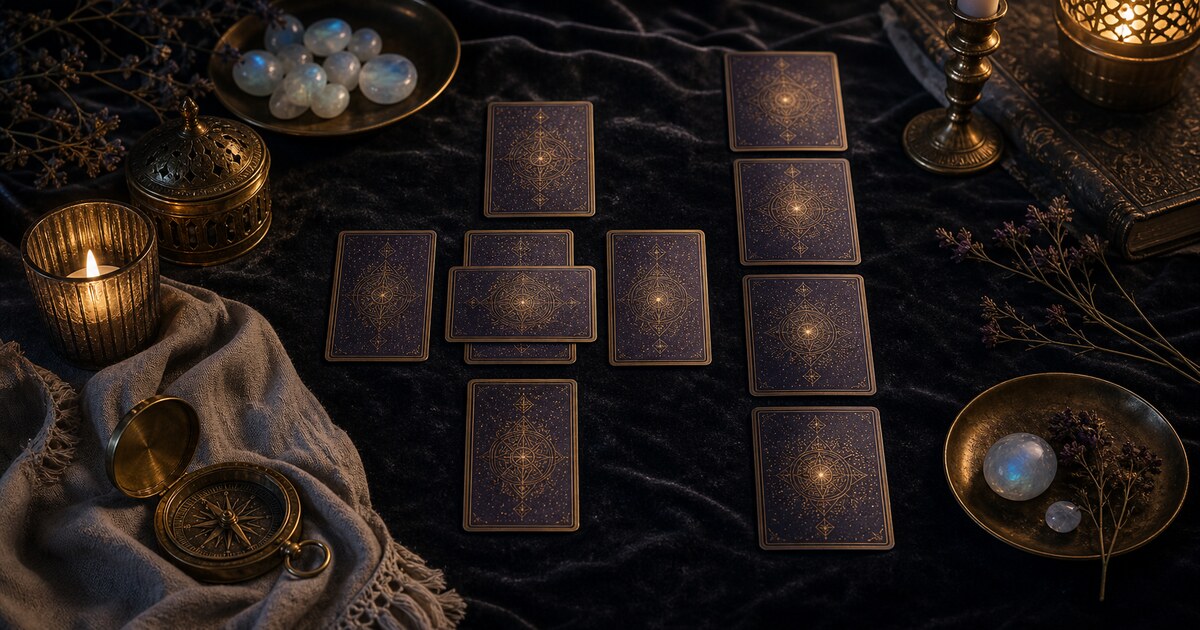
The Celtic Cross consists of two sections: a cross formation of six cards on the left and a staff (vertical column) of four cards on the right. Here is each position, its placement, and its detailed meaning.
The Cross (Positions 1-6)
Position 1: The Present / The Heart of the Matter
Placement: Center of the cross.
This card represents the core of the situation, the central theme or energy that defines what the reading is about. It describes the querent’s current state, the primary issue at hand, or the dominant energy surrounding the question. Think of it as the thesis statement of the entire reading. Every other card in the spread relates back to this one.
When interpreting Position 1, resist the urge to make it too specific too quickly. This card sets the tone and theme. If you draw El Emperador, the reading is fundamentally about structure, authority, control, and order. If you draw the Cinco de Copas, the core theme is loss, grief, and the struggle to see what remains. Let this card establish the emotional and thematic center of gravity before moving to the other positions.
Position 2: The Crossing Card / The Challenge
Placement: Laid horizontally across Position 1, forming a small cross.
This is one of the most nuanced positions in the spread. The crossing card represents the primary obstacle, challenge, or opposing force that the querent faces in relation to the central issue. It is what is blocking progress, creating tension, or demanding attention. Some readers interpret a “positive” card in this position as a force that, while beneficial in general, is creating complications in this specific context. For example, the Dos de Copas crossing might indicate that a relationship, while positive overall, is complicating the situation described by Position 1.
The interaction between Position 1 and Position 2 is the most important dynamic in the entire spread. These two cards together define the fundamental tension of the reading. If Position 1 is the protagonist, Position 2 is the antagonist, not necessarily something evil, but the opposing force that creates the story’s central conflict.
Position 3: The Foundation / Root Cause
Placement: Below the central cross.
This card reveals the underlying foundation of the situation: its root cause, origin, or the subconscious factors that created the current circumstances. It represents what lies beneath the surface, the bedrock upon which the present situation was built. This position often points to past events, deep-seated beliefs, childhood patterns, or fundamental motivations that the querent may not be consciously aware of.
Position 3 is where the reading begins to develop depth. While Positions 1 and 2 describe the surface-level situation and its immediate obstacle, Position 3 explains why. If Position 1 shows financial struggle and Position 2 shows fear, Position 3 might reveal that the root cause is a childhood experience of scarcity that created the fear that now perpetuates the financial struggle. This positional depth is what separates the Celtic Cross from simpler spreads.
Position 4: The Recent Past
Placement: To the left of the central cross.
This card describes events, energies, or influences from the recent past that are directly connected to the current situation. “Recent” is relative; it could mean the last few weeks, months, or the last significant event that shaped the current reality. This position shows what is just now passing out of influence but still casts a shadow over the present.
Position 4 provides temporal context. It explains how the querent arrived at the present moment. If this card shows a positive energy, it may represent a resource or advantage that was recently available but is now fading. If it shows a difficult energy, it represents a challenge that has been navigated and is now receding, leaving its effects behind. Either way, this card is moving away from center stage.
Position 5: The Crown / Best Possible Outcome or Conscious Goal
Placement: Above the central cross.
This position represents the best possible outcome available in the situation, the querent’s conscious goals, or what they are striving toward. Some readers interpret it as what crowns the situation, the highest potential that exists if everything goes well. Others see it as the querent’s conscious desires and aspirations regarding the issue at hand.
Position 5 is aspirational. It shows what could be, what the querent hopes for, or what the universe is making available as a possibility. It is not a guarantee but rather a potential that may or may not be realized depending on the choices made and the energies described by the rest of the spread. When the Crown card aligns well with the Outcome card (Position 10), it suggests the querent’s hopes are likely to be fulfilled. When they conflict, it indicates a gap between desire and reality that needs to be addressed.
Position 6: The Near Future
Placement: To the right of the central cross.
This card describes what is approaching in the near future, typically the next few weeks to months. It represents the next energy that will enter the situation, the next event on the horizon, or the next shift in the dynamic. Unlike the final Outcome card, Position 6 describes a transitional phase, what happens next but not the ultimate conclusion.
Position 6 is where the reading begins to become predictive. The first five positions establish the present, its challenges, its roots, its recent history, and its potential. Position 6 starts pointing forward. This card is particularly actionable because it describes something that is imminent enough to prepare for but has not yet arrived, giving the querent a window to adjust their approach.
The Staff (Positions 7-10)
Position 7: The Self / Your Attitude
Placement: Bottom of the vertical column on the right.
This card represents the querent themselves: their attitude, self-image, approach to the situation, and the energy they are bringing to the dynamic. It reflects how the querent sees themselves in relation to the issue at hand and what role they are playing, consciously or unconsciously.
Position 7 is a mirror. It shows the querent their own contribution to the situation, which can be enlightening or uncomfortable depending on the card. If the querent sees themselves as a victim but Position 7 shows the Rey de Bastos, the reading is suggesting they have more power and agency than they realize. If they see themselves as having everything under control but Position 7 shows the Cinco de Espadas, the reading is revealing a combative or self-defeating pattern they may not acknowledge.
Position 8: External Influences / Environment
Placement: Second from the bottom in the vertical column.
This card represents the external environment, other people’s influence, societal or cultural factors, and circumstances outside the querent’s control that are affecting the situation. It describes the world around the querent as it relates to the question, the pressures, supports, expectations, and dynamics that exist in their environment.
The relationship between Position 7 (Self) and Position 8 (Environment) is crucial. Together, they reveal the dynamic between the querent’s inner world and their outer reality. If both cards are harmonious, the querent is in alignment with their environment. If they conflict, there is friction between who the querent is or wants to be and what their circumstances demand or allow.
Position 9: Hopes and Fears
Placement: Third from the bottom in the vertical column.
This is one of the most psychologically revealing positions in the spread. It represents the querent’s deepest hopes and fears regarding the situation. The genius of this position is that hopes and fears are often two sides of the same coin. What we most hope for is often intimately connected to what we most fear. The person who hopes desperately for a committed relationship may simultaneously fear the vulnerability that commitment requires. The person who hopes for career success may fear the responsibility and scrutiny it brings.
When interpreting Position 9, consider both dimensions: what hope does this card represent, and what fear? Often, a single card captures both aspects of the querent’s emotional investment in the situation. A card like the Diez de Pentáculos might represent the hope for financial security and family legacy alongside the fear of losing everything that has been built. The Tower might represent the fear of sudden destruction alongside the secret hope for liberation from a confining structure.
Position 10: The Outcome
Placement: Top of the vertical column.
This is the card everyone looks at first, though it should be interpreted last. Position 10 represents the final outcome of the situation if current energies continue on their present course. It is the culmination of everything the spread has revealed: the central issue, the challenge, the roots, the past, the potential, the near future, the self, the environment, and the hopes and fears all converge into this concluding card.
Crucially, the Outcome card is not a fixed destiny. It is a trajectory. It shows where things are heading given the current configuration of forces, but the querent always has agency. If the Outcome card is undesirable, the reading has actually done its most important work: it has shown you the result of continuing on the current path, which means you can change course. The other nine cards, particularly Position 2 (the challenge to overcome) and Position 7 (your attitude and approach), offer specific leverage points for altering the outcome.
Step-by-Step Reading Process
Now that you understand each position, here is a systematic process for performing and interpreting a complete Celtic Cross reading.
Step 1: Formulate the Question
The quality of a Celtic Cross reading depends heavily on the quality of the question. Open-ended questions work better than yes-or-no questions with this spread. Instead of “Will I get the job?” ask “What do I need to know about my career path?” Instead of “Does he love me?” ask “What is the truth of this relationship?” The Celtic Cross is designed to reveal complexity and nuance, so give it a question worthy of its depth.
Write your question down. This simple act clarifies your intention and gives you a reference point to return to when the interpretation gets complex. During the reading, every card should be interpreted in direct relationship to this written question.
Step 2: Shuffle and Draw
Shuffle the deck while holding the question in your mind. Some readers shuffle until a card falls out, others shuffle a set number of times, and others shuffle until they feel a sense of completion. Use whatever method resonates with you. Draw ten cards and place them face-down in their designated positions before turning any of them over. This allows you to see the complete layout before interpretation begins.
Step 3: First Impression Scan
Turn all ten cards face-up and take a moment to observe the spread as a whole before analyzing individual cards. Note your immediate emotional response. Does the spread feel heavy, light, turbulent, calm, hopeful, or challenging? This gut-level first impression is remarkably accurate and provides a framework for the detailed analysis that follows.
During this scan, notice the following macro-level patterns:
- Major Arcana count: Cómo many of the ten cards are from the Major Arcana? More Major Arcana cards indicate a situation involving powerful, archetypal, and possibly karmic forces. Fewer Major Arcana cards suggest a situation that is more within the querent’s personal control.
- Dominant suit: Is one suit overrepresented? Three or more cards from one suit suggest the situation is primarily emotional (Cups), practical/financial (Pentacles), mental/communicative (Swords), or creative/action-oriented (Wands).
- Court Card count: Multiple Court Cards indicate that other people play a significant role in the situation.
- Reversed card count: If you read reversals, many reversed cards suggest blocked energy, internalized processes, or a situation that is not yet ready for external expression.
- Color and imagery: Notice the visual tone of the spread. Dark, stormy imagery creates a different atmosphere than bright, floral imagery. Trust what your eyes tell you.
Step 4: Read the Central Cross First
Begin with Positions 1 and 2, the heart and the crossing. Describe the fundamental tension or dynamic of the reading. Then read Position 3 (the root) to understand what created this dynamic. Next, read Position 4 (the recent past) to see what has just transpired. Then Position 5 (the crown/potential) to understand what is possible. Finally, read Position 6 (the near future) to see what is approaching.
By this point, you should have a clear narrative: “Here is the core issue (1), here is what is blocking it (2), here is why (3), here is where you just were (4), here is what could be (5), and here is what is coming next (6).”
Step 5: Read the Staff
Now interpret Positions 7 through 10, which add the human dimension to the situational narrative. Position 7 shows the querent’s attitude and self-image. Position 8 shows the external world’s influence. Position 9 reveals the psychological undercurrent of hopes and fears. Position 10 provides the conclusion.
Step 6: Synthesize
The final and most challenging step is weaving all ten cards into a single, coherent narrative. This is where the Celtic Cross demands true skill. Do not simply deliver ten individual card interpretations; instead, tell a story that begins with the root cause (Position 3), moves through the recent past (Position 4) to the present situation (Position 1), encounters the challenge (Position 2), is shaped by the querent’s attitude (Position 7) and their environment (Position 8), reaches toward potential (Position 5) through the near future (Position 6), is fueled by hopes and haunted by fears (Position 9), and arrives at the outcome (Position 10).
A Complete Sample Reading
Let us walk through a full Celtic Cross reading to demonstrate how these principles work in practice.
Question: “What do I need to understand about my current relationship?”
Cards drawn:
| Position | Card |
|---|---|
| 1. Present | Dos de Copas |
| 2. Crossing | Cinco de Espadas |
| 3. Foundation | La Emperatriz |
| 4. Recent Past | Ocho de Bastos |
| 5. Crown | Diez de Copas |
| 6. Near Future | Cuatro de Espadas |
| 7. Self | Reina de Pentáculos |
| 8. Environment | Tres de Espadas |
| 9. Hopes/Fears | Los Enamorados |
| 10. Outcome | La Templanza |
First Impression Scan
Three Major Arcana cards (La Emperatriz, Los Enamorados, La Templanza) suggest significant archetypal forces at play. The spread has a mix of suits with two Swords cards indicating some mental tension. The visual atmosphere blends warmth (Cups, Empress, Reina de Pentáculos) with sharpness (Swords cards). Overall feeling: a fundamentally loving relationship under genuine stress, with a hopeful trajectory.
Detailed Interpretation
Position 1 (Dos de Copas): The heart of the matter is a genuine, reciprocal emotional connection. This is a real partnership with mutual affection, shared values, and emotional resonance. The core of the relationship is sound.
Position 2 (Cinco de Espadas crossing): The challenge is conflict that has produced winners and losers. Someone feels defeated in recent arguments. There is an imbalance in how disagreements are handled, perhaps one person dominates while the other withdraws. The Cinco de Espadas suggests that the way you fight, not the underlying love, is the real problem.
Position 3 (La Emperatriz): The foundation of this relationship is nurturing, sensuality, and creative abundance. You came together through a deep appreciation for beauty, comfort, and caring for each other. This nurturing impulse is the root strength of the bond. La Emperatriz also suggests that fertility, creativity, or the desire to build something together (a home, a family, a shared life) was the original motivating force.
Position 4 (Ocho de Bastos): The recent past was a period of rapid movement: many messages, fast developments, perhaps events moving faster than either partner could process. Things happened quickly recently, maybe too quickly, and this velocity did not leave enough space for careful communication, which may be contributing to the Cinco de Espadas conflict pattern.
Position 5 (Diez de Copas): The crown of this reading is the Diez de Copas, the ultimate card of emotional fulfillment and family happiness. This is what the relationship could become at its best. The potential here is extraordinary: lasting happiness, deep emotional fulfillment, and a love that sustains and enriches both partners. This potential is real and available.
Position 6 (Cuatro de Espadas): The near future brings a period of rest, retreat, and mental recovery. After the rapid pace (Ocho de Bastos) and the conflict pattern (Cinco de Espadas), both partners need to step back and heal. This might manifest as a few days of quiet distance, a conscious decision to stop arguing and simply rest, or a timeout to reflect individually before re-engaging.
Position 7 (Reina de Pentáculos): You bring the energy of the Reina de Pentáculos to this relationship: practical, nurturing, grounded, and materially supportive. You show love through acts of service, creating comfort, and providing stability. This is a genuine strength, but it also suggests you might be so focused on practical care that you neglect emotional or verbal expression of love.
Position 8 (Tres de Espadas): The external environment carries the energy of heartbreak, painful truths, and emotional wounds. This might represent outside opinions that are hurting the relationship (family members, friends, or social media creating comparison and insecurity), or it could indicate that broader life circumstances (work stress, health issues, loss) are creating an atmosphere of pain that seeps into the partnership.
Position 9 (Los Enamorados): The hope and fear are one and the same: true, deep, soul-level love. You hope this is the real thing, the divine partnership the Lovers card represents. You fear it is not, or that you are not worthy of it, or that you will lose it. This card reveals how deeply invested you are in this relationship’s sacred potential.
Position 10 (La Templanza): The outcome is La Templanza: balance, healing, patience, and the alchemical integration of opposites. This is a profoundly positive outcome card for a relationship question. It does not promise fireworks or dramatic gestures, but something better: sustainable harmony achieved through patience, mutual adjustment, and the slow blending of two individuals into something greater than either alone. The conflict (Cinco de Espadas) will be resolved not through victory or defeat but through the gradual, conscious balancing act that La Templanza represents.
Synthesized Narrative
Your relationship is built on a foundation of genuine nurturing and creative abundance (Empress), and at its core, the love between you is real and reciprocal (Dos de Copas). Cómoever, a pattern of hurtful conflict (Cinco de Espadas) has developed, possibly accelerated by a recent period of rapid change (Ocho de Bastos) and aggravated by external sources of pain (Tres de Espadas). Your practical, caring approach (Reina de Pentáculos) is a strength but may need to be complemented by more direct emotional communication. Your deepest hope and fear center on whether this love is truly sacred and lasting (Lovers). The near future calls for a healing pause (Cuatro de Espadas), and if you honor that need, the ultimate outcome is a beautifully balanced, temperate, and sustainable partnership (La Templanza) that fulfills the extraordinary potential (Diez de Copas) this relationship genuinely holds.
Common Patterns in Celtic Cross Readings
After performing hundreds or thousands of Celtic Cross readings, experienced readers begin to recognize recurring patterns that carry interpretive significance beyond individual card meanings.
The Mirroring Pattern
When positions on opposite sides of the spread echo similar themes or energies, it creates a mirroring effect that amplifies the message. For example, if Position 3 (Foundation) and Position 5 (Crown) both contain cards of the same suit, it suggests that the root and the potential are aligned: the seed that was planted is growing toward the fruit it was meant to produce. If Positions 1 and 10 mirror each other, the present situation and the outcome are in harmony, suggesting things will resolve in a way consistent with the current energy.
The Blocking Pattern
When Position 2 (the Crossing) is reinforced by Position 8 (Environment) or Position 9 (Hopes/Fears), the obstacle is deeply entrenched. It is not just an external challenge but one supported by the querent’s environment and psychological patterns. These readings require significant inner and outer work to shift the dynamic, and the solution often lies in Position 7 (Self), where the querent can change their own attitude and approach.
The Escalation Pattern
When the cards become progressively more intense from left to right (Positions 4 through 6) and from bottom to top (Positions 7 through 10), the situation is building toward a climax. The stakes are rising, the energy is intensifying, and the outcome will be significant. These readings often involve Major Arcana cards in the later positions and suggest a period of major life change.
The Resolution Pattern
When Positions 1 and 2 show conflict but Positions 6 and 10 show resolution, the reading has a fundamentally optimistic arc despite present difficulties. The current struggle is real but temporary. If the resolution cards are Minor Arcana, the resolution will come through practical, everyday actions. If they are Major Arcana, the resolution involves a significant shift in perspective or a transformative event.
The Stagnation Pattern
When multiple cards in the spread suggest waiting, stillness, or blocked energy (Cuatro de Espadas, Dos de Espadas, Colgado, Cuatro de Copas, Ocho de Espadas), the reading is describing a period of necessary pause. Nothing is moving because nothing should move yet. The querent’s impatience or desire for resolution may itself be the obstacle. These readings call for surrender, patience, and trust in divine timing.
Advanced Celtic Cross Techniques
Quintessence Card Calculation
The quintessence card is derived by adding up the numerical values of all ten cards in the spread and reducing the sum to a number between 1 and 22 (corresponding to the Major Arcana). Court Cards are typically assigned values: Pages = 11, Knights = 12, Queens = 13, Kings = 14. The resulting Major Arcana card provides an overarching theme or spiritual lesson that encompasses the entire reading. For example, if the sum reduces to 6, Los Enamorados is the quintessence, suggesting the reading’s ultimate lesson concerns choices, values, and relationships.
Elemental Flow Analysis
Assign each card its elemental correspondence (Wands = Fire, Cups = Water, Swords = Air, Pentacles = Earth, Major Arcana = Spirit) and trace the elemental flow across the spread. Are there transitions from one element to another as you move through the positions? A reading that begins in Water (emotional) and ends in Earth (practical) suggests a journey from feeling to action. One that moves from Air (mental) to Fire (passionate) shows thoughts igniting into action.
Dignity Chains
In adjacent positions, assess whether the cards support or undermine each other based on elemental compatibility. Fire and Air support each other. Water and Earth support each other. Fire and Water weaken each other. Air and Earth weaken each other. Fire and Earth are neutral, as are Water and Air. These dignity relationships add subtlety to the reading by showing where energy flows smoothly and where it encounters friction at a structural level.
Timing Techniques
The Celtic Cross can be used for timing predictions. Position 4 represents the recent past (typically 1-3 months back), Position 6 represents the near future (typically 1-3 months forward), and Position 10 represents the longer-term outcome (typically 3-12 months). Some readers assign specific timing based on suits: Wands suggest days to weeks, Cups suggest weeks to months, Swords suggest days to weeks (due to Air’s speed), and Pentacles suggest months to years (due to Earth’s slow pace). Use these as guidelines, not rigid rules.
The Shadow Crossing
Some advanced readers draw an eleventh card, placed beneath the crossing card, to represent the shadow aspect of the challenge. This card reveals the hidden dimension of the obstacle that the conscious mind is not acknowledging. It transforms Position 2 from a single challenge into a layered complex, showing both the visible obstacle and its unseen root.
Common Mistakes and Cómo to Avoid Them
Reading Position 10 First
The temptation to flip directly to the Outcome card is nearly irresistible, but it undermines the entire reading. Position 10 only makes sense in the context of the nine cards that precede it. Without that context, you are reading a single card in isolation, which any card-of-the-day pull could accomplish. Discipline yourself to read the positions in order, building the narrative layer by layer.
Treating Each Card as Independent
The most common mistake in Celtic Cross readings is interpreting ten separate cards rather than one interconnected narrative. The cards relate to each other. Position 2 modifies Position 1. Position 3 explains Position 1. Position 7 interacts with Position 8. Position 9 shapes the emotional context for Position 10. Spend as much time on connections between cards as you do on individual card meanings.
Ignoring the Question
Every card must be interpreted in relation to the question asked. The As de Copas means something different in a career reading than in a love reading. If the question is about finances and La Emperatriz appears, interpret it through a financial lens (abundance, material fertility, creative income) rather than defaulting to its most common keyword (motherhood). The question is the compass that orients every interpretation.
Overloading With Clarifier Cards
When a card is confusing, some readers pull additional “clarifier” cards. In a ten-card spread, this quickly leads to thirteen, fifteen, or twenty cards, destroying the structural integrity of the layout. If a card is unclear, use the surrounding positions as clarifiers. That is what they are there for. Position 3 clarifies why Position 1 exists. Position 8 clarifies the external factors affecting Position 7. The spread itself is designed to be internally clarifying.
Delivering Only Bad News
Challenging cards appear in every reading because life contains challenges. But every spread also contains resources, strengths, and positive potentials. Even in the most difficult Celtic Cross, there are positions that reveal what the querent has going for them. A responsible reader identifies both the challenges and the resources, the problems and the paths forward. The Celtic Cross is a diagnostic and prescriptive tool, not merely a catalog of doom.
Celtic Cross Variations
While the standard ten-card layout is the most widely used, several meaningful variations have developed over the years.
The Modified Celtic Cross With Significator
Some readers begin by selecting a significator card, a card chosen deliberately to represent the querent, and placing it in the center before drawing the spread. The ten cards are then drawn and placed around the significator. This pre-selected card anchors the reading to the querent’s identity and ensures that every card is interpreted in relationship to a known reference point. Common significator choices include Court Cards that match the querent’s zodíaco sign element or the Major Arcana card associated with their Sun sign.
The Expanded Celtic Cross
Some readers add an eleventh through thirteenth card: one for the querent’s secret self (placed beneath Position 7), one for the hopes and fears of the other person involved (placed beside Position 9), and one for the universal lesson (placed above Position 10). This expansion adds depth for complex interpersonal situations but requires significant skill to synthesize.
The Celtic Cross for Timing
In this variation, specific time frames are assigned to each position. Position 4 represents one month ago, Position 1 represents the present week, Position 6 represents one month ahead, and Position 10 represents six months to one year ahead. The remaining positions maintain their standard meanings but are interpreted with these time stamps in mind. This is particularly useful for long-range planning and goal-setting.
When to Use the Celtic Cross (and When Not To)
Ideal Situations for the Celtic Cross
- Complex, multifaceted questions that involve multiple people, factors, or layers of meaning.
- Significant life decisions where you need to understand not just the likely outcome but the forces shaping it.
- Relationship questions where both partners’ energies, the environment, and the underlying dynamics need to be mapped.
- Career and life-path questions where past experiences, current skills, environmental factors, and future potential all matter.
- Shadow work and self-discovery where the subconscious, conscious, and aspirational layers of the self need exploration. For more on this topic, explore our guide to shadow work through astrology.
- Annual or seasonal check-ins where you want a comprehensive overview of your life’s current state and trajectory.
When Simpler Spreads Are Better
- Quick daily guidance: A three-card spread or single card pull is more appropriate for morning check-ins.
- Yes-or-no questions: The Celtic Cross is over-engineered for binary questions. Use a single-card pull.
- When you are emotionally overwhelmed: Ten cards can intensify anxiety. If you are in a fragile state, start with fewer cards and expand only if you feel ready.
- When you already know the answer: If you are using tarot to confirm a decision you have already made, a single confirmation card is sufficient. The Celtic Cross will not tell you anything you do not already know in this case; it will just take longer to say it.
Developing Celtic Cross Mastery
Practice Structure
Perform at least one Celtic Cross reading per week, alternating between reading for yourself and reading for others. After each reading, write a complete narrative interpretation (not just card-by-card notes) and revisit it a month later to assess accuracy. This practice loop of performance, documentation, and review is how mastery develops.
Study Card Interactions
Create a journal specifically for recording interesting card combinations that appear across positions. Over time, you will develop a personal lexicon of positional pairings that speak to you with particular clarity. The Cinco de Copas in Position 3 combined with the Seis de Copas in Position 5, for example, might become your signature pattern for “nostalgic grief that must be processed before childhood joy can be recaptured.”
Read Multiple Interpretive Traditions
Study how different tarot authors interpret the Celtic Cross positions. Read Waite’s original descriptions, then compare them with modern interpreters like Mary K. Greer, Rachel Pollack, Benebell Wen, and Dusty White. Each offers slightly different positional nuances, and synthesizing multiple perspectives deepens your understanding immeasurably.
Integrate With Other Systems
The Celtic Cross gains depth when integrated with carta natal astrology, numerology, and elemental analysis. The astrological associations of the Major Arcana cards, the numerological values of the Minor Arcana, and the elemental correspondences of the suits all provide additional interpretive layers. A reader who understands that the Tres de Copas is numerologically linked to Jupiter and Venus, and astrologically connected to Mercury in Cancer, can extract significantly more meaning from its appearance in any position.
The Celtic Cross is the tarot reader’s equivalent of a symphonic performance: complex, demanding, and extraordinarily rewarding when executed well. It asks more of you than any other spread, but it gives more in return. Every serious tarot practitioner should develop a deep, practiced relationship with this layout, not because tradition demands it, but because no other spread offers the same depth, nuance, and comprehensiveness for exploring life’s most important questions. Master the Celtic Cross, and you will find that every other spread becomes easier, because you will have developed the skills of synthesis, narrative construction, and positional awareness that underpin all effective lectura de tarot.