Sun Sign vs. Moon Sign vs. Rising Sign: What Is the Difference?
One of the most common frustrations in astrology is reading your horoscope or Sun sign description and thinking, “That doesn’t sound like me at all.” If you have ever felt disconnected from your zodiac sign, the explanation is almost certainly that you have been looking at only one piece of a much larger puzzle. Your Sun sign is important, but it is just one of three foundational placements that shape who you are. When you also consider your Moon sign and your Rising sign, the picture changes dramatically — and suddenly, astrology starts to make a lot more sense.
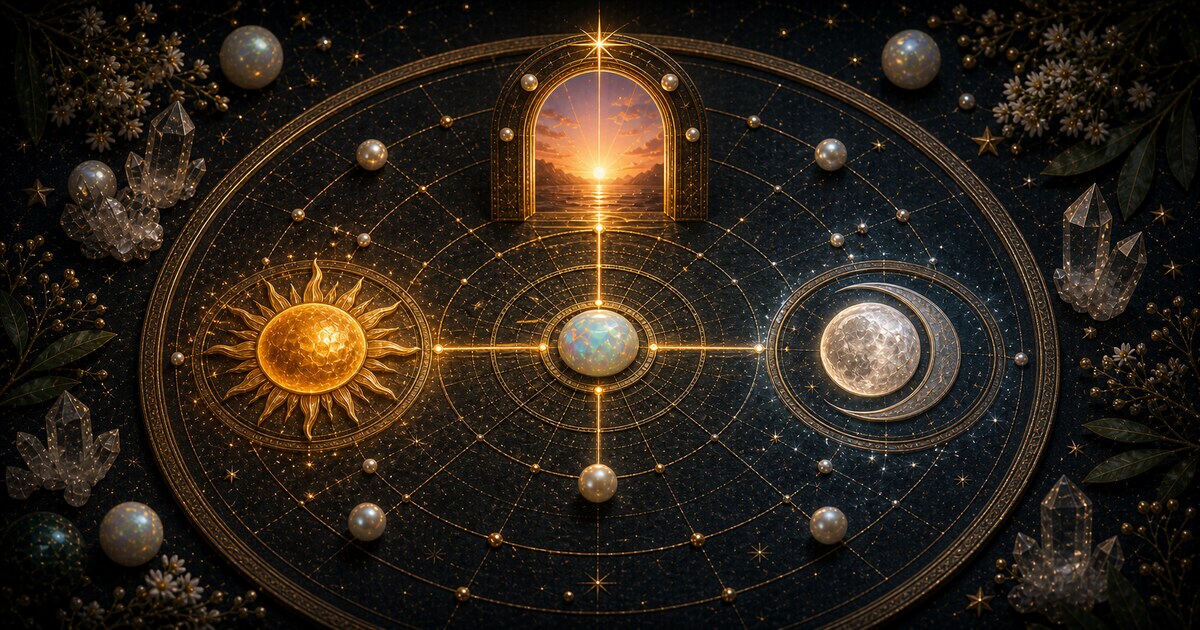
These three placements, collectively known as the Big Three, each represent a fundamentally different dimension of your personality. Your Sun sign is your conscious identity and life direction. Your Moon sign is your emotional core and inner world. Your Rising sign is your social persona and the way the world perceives you. They can be in the same sign, creating a concentrated expression of that sign’s energy, or in very different signs, creating a layered, sometimes contradictory personality that no single zodiac description could ever capture.
In this article, we will break down exactly what each of these three placements represents, explore the differences between them in detail, explain why so many people do not resonate with their Sun sign, and show you how all three work together to create the complete picture of your astrological identity.
The Sun Sign: Who You Are Becoming
Your Sun sign is the placement most people know. It is determined by which zodiac sign the Sun was transiting on the day you were born. Because the Sun stays in each sign for roughly thirty days, everyone born within that period shares the same Sun sign. This is the basis of the twelve-sign horoscope system that has dominated popular astrology for nearly a century.
What the Sun Sign Represents
The Sun in astrology represents your core identity, your ego, your willpower, your vitality, and the qualities you are actively developing and expressing throughout your life. It is the center of your personality — the gravitational force that gives coherence to all the other elements of your chart. The Sun sign describes the kind of person you are striving to become, the qualities that give you a sense of purpose and pride when you express them fully.
The key word for the Sun is identity. It answers the question “Who am I?” at the most fundamental level. When someone asks you to describe yourself, the qualities that come to mind are usually Sun sign qualities, even if you have never studied astrology. The Aries Sun who says “I’m competitive and love a challenge.” The Virgo Sun who says “I’m detail-oriented and like things organized.” The Pisces Sun who says “I’m creative and deeply empathic.”
The Sun Sign as a Process
An important nuance that pop astrology often misses is that the Sun sign is not a fixed description of who you already are — it is a description of who you are growing into. Young children often express their Moon sign and Rising sign more visibly than their Sun sign, because the Sun sign requires conscious development. You are not born a fully formed version of your Sun sign. You become it over time, through choices, experiences, and the gradual unfolding of your potential.
This is one reason why some people, especially younger individuals, do not resonate strongly with their Sun sign. They may not yet have had the life experiences that activate and develop those qualities. As people mature, they typically identify more and more with their Sun sign, because they have done the work of becoming it.
What the Sun Sign Does Not Tell You
The Sun sign cannot tell you about your emotional needs, your instinctive reactions, your first impressions on others, your physical appearance tendencies, or the area of life where your emotional energy is most invested. These are governed by the Moon sign, Rising sign, and house placements, respectively. The Sun sign gives you the “what” of your identity but not the “how” of your emotional life or the “where” of your life focus.
The Moon Sign: Who You Are Inside
Your Moon sign is determined by which zodiac sign the Moon was transiting at the exact time of your birth. Because the Moon moves much faster than the Sun — changing signs every two to two and a half days — you need your birth time (at least approximately) to determine your Moon sign accurately. Two people born on the same day might have different Moon signs if the Moon changed signs during that twenty-four-hour period.
What the Moon Sign Represents
The Moon in astrology represents your emotional nature, your instinctive reactions, your deepest needs, your comfort zone, and your unconscious patterns. If the Sun is who you are in public, the Moon is who you are when no one is watching. It governs your private inner world — the thoughts, feelings, and needs that you may not even be fully conscious of, but that profoundly shape your behavior, your choices, and your experience of life.
The key word for the Moon is emotion. It answers the question “What do I need to feel safe, nurtured, and emotionally fulfilled?” The Moon sign reveals how you process feelings, what brings you comfort, how you care for yourself and others, and what kind of environment you need in order to thrive emotionally.
The Moon is also closely connected to your early childhood and your relationship with your mother or primary caretaker. The emotional patterns established in your earliest years tend to be Moon sign patterns, and they continue to operate at a deep, often automatic level throughout your life.
The Moon Sign in Relationships
In intimate relationships, the Moon sign reveals itself more fully than in any other context. When you feel safe enough to let your guard down, it is your Moon sign that emerges — your emotional needs, your comfort-seeking behaviors, your way of nurturing and wanting to be nurtured. Many relationship conflicts arise not from Sun sign incompatibility but from mismatched Moon sign needs. One partner might have a Capricorn Moon that craves structure and space, while the other has a Cancer Moon that craves constant emotional closeness. Both are valid needs, but they can clash if neither partner understands the astrological dynamic at play.
Understanding your partner’s Moon sign can be transformative for your relationship, because it helps you speak to their emotional core rather than just their surface personality. When you know that your partner’s Cancer Moon needs reassurance and emotional safety, you can provide that even if their Aries Sun makes them seem independent and tough.
What the Moon Sign Does Not Tell You
The Moon sign does not describe your conscious identity, your life purpose, your public persona, or how others perceive you on first meeting. It operates in the background, shaping your emotional responses and inner life but not necessarily visible to people who do not know you well. Someone might know you for years in a professional context and never see your Moon sign in action.
The Rising Sign: How the World Sees You
Your Rising sign (Ascendant) is determined by the zodiac sign that was rising over the eastern horizon at the exact moment and place of your birth. It changes approximately every two hours, making it the most time-sensitive of the Big Three and the most unique to your specific birth moment. You absolutely need your precise birth time and location to determine your Rising sign.
What the Rising Sign Represents
The Rising sign represents the face you show to the world, your first impression on others, the way you instinctively approach new situations, and the lens through which you filter all of your experiences. It is sometimes described as a mask or persona, though this can be misleading — it is not a false front but rather a genuine outer layer of your personality, the qualities that are most immediately visible and accessible to others.
The key word for the Rising sign is impression. It answers the question “How do others experience me when they first meet me?” Your Rising sign shapes everything from your physical appearance and body language to your default social manner and the way you enter a room. It is the automatic setting of your personality, the version of you that shows up before you have had a chance to consciously decide how to present yourself.
The Rising sign also has profound structural importance in the natal chart. It determines the house cusps, which means it dictates the life area governed by each section of your chart. Two people with the same Sun and Moon signs but different Rising signs will have their planets distributed across different houses, giving them very different life emphases and areas of focus.
What the Rising Sign Does Not Tell You
The Rising sign does not describe your core values, your life purpose, your emotional needs, or your deepest motivations. It describes the surface — how you look, how you come across, how you navigate social situations — but not the depths beneath that surface. People who know you only casually are responding primarily to your Rising sign. People who know you deeply are connecting with your Sun and Moon.
The Key Differences at a Glance
To clarify the distinctions between these three placements, here is a side-by-side comparison:
- Sun Sign — Represents: core identity, ego, life purpose. When it shows: when you are being authentic and purposeful. Determined by: birth date. Changes: every 30 days approximately.
- Moon Sign — Represents: emotions, instincts, inner needs. When it shows: in private, in intimate relationships, under stress. Determined by: birth date and time. Changes: every 2.5 days approximately.
- Rising Sign — Represents: first impression, appearance, social persona. When it shows: upon first meeting, in new situations, in public. Determined by: birth date, time, and location. Changes: every 2 hours approximately.
Another way to think about it: if your personality were a building, your Rising sign would be the facade — the first thing people see from the street. Your Sun sign would be the main living area — the space where you spend most of your conscious time and where your personality is most fully expressed. Your Moon sign would be the bedroom — the private, intimate space where you are most vulnerable and most truly yourself.
Why You Might Not Feel Like Your Sun Sign
This is one of the most common complaints people have about astrology, and the Big Three framework almost always explains it. There are several reasons why someone might not identify with their Sun sign:
Your Moon Sign Dominates
If your Moon sign is in a very different element or modality from your Sun sign, your emotional nature may feel more prominent to you than your conscious identity, especially in your younger years. For example, a Capricorn Sun with an Aries Moon might identify more with the impulsive, fiery, action-oriented qualities of Aries than with the patient, disciplined, strategic qualities of Capricorn. Internally, they experience the world through an Aries emotional lens, even though their life path and conscious goals are Capricorn-flavored.
Your Rising Sign Is Very Different from Your Sun Sign
Because the Rising sign is the outermost layer and the most immediately visible, it strongly shapes how others respond to you. If your Rising sign is very different from your Sun sign, people may reflect back an image of you that does not match how you see yourself internally. A Scorpio Sun with a Sagittarius Rising might hear people describe them as fun, outgoing, and easygoing — which feels inaccurate because their inner world is intense, private, and complex. Over time, this disconnect between external perception and internal experience can lead to confusion about which sign “really” describes them.
Other Chart Factors Are Strong
A stellium (three or more planets) in a sign different from your Sun sign can significantly shift your personality expression. If you have a Libra Sun but four planets in Scorpio, Scorpio energy may dominate your chart despite not being your Sun sign. Similarly, a planet conjunct your Ascendant or Midheaven can be so prominent that it overshadows your Sun sign characteristics.
You Are Reading the Wrong Horoscope
Many experienced astrologers recommend reading your horoscope for your Rising sign rather than (or in addition to) your Sun sign. Because horoscopes are based on transits to house positions, and your house positions are determined by your Rising sign, your Rising sign horoscope can actually be more accurate and specific than your Sun sign horoscope. If you have been reading only your Sun sign horoscope and finding it unhelpful, try reading your Rising sign horoscope instead.
How All Three Signs Work Together
The real power of the Big Three emerges when you understand how all three signs interact as a system. They are not three separate personalities but three dimensions of a single, integrated personality. Here is how they work together in practice.
The Layering Effect
When you meet someone new, they encounter your Rising sign first. It is your default social mode, your automatic way of presenting yourself. As they get to know you better, they begin to see your Sun sign — your conscious values, goals, and identity. Only in intimate or emotionally charged situations do they encounter your Moon sign — your raw emotional core, your vulnerabilities, your deepest needs.
This layering means that people who know you at different levels of intimacy may have very different impressions of who you are. Your coworkers see your Rising sign and some of your Sun sign. Your close friends see your Sun sign and glimpses of your Moon sign. Your partner sees all three, sometimes in rapid succession.
Internal Harmony and Tension
The relationship between your Big Three signs creates a specific internal dynamic. When all three are in compatible elements (for example, fire Sun, fire Moon, air Rising), there is a sense of internal consistency and ease. You feel like a coherent person, and people at different levels of intimacy perceive you similarly.
When your Big Three are in tense aspects (for example, a cardinal Sun, fixed Moon, and mutable Rising), there can be a sense of internal fragmentation or complexity. Different situations bring out very different sides of you, and you may feel like you contain multitudes that do not always get along with each other. This is not a negative thing — it often creates depth, resilience, and the ability to adapt to diverse situations. But it does mean that understanding your Big Three is especially important for self-integration.
Practical Examples
Let’s look at some specific examples to illustrate how the Big Three work together in real life:
Example 1: Leo Sun, Virgo Moon, Scorpio Rising
First impression (Scorpio Rising): Intense, penetrating, somewhat intimidating. People sense power and mystery. Core identity (Leo Sun): Creative, warm, generous, wants to be seen and appreciated. Emotional core (Virgo Moon): Anxious, analytical, needs order and practical routines to feel secure. The result: Someone who appears formidable and mysterious but is actually a warm, creative person underneath, with a surprisingly practical and perfectionist emotional life. The Scorpio Rising intimidates, the Leo Sun charms, and the Virgo Moon worries about whether everything is done right.
Example 2: Pisces Sun, Aries Moon, Libra Rising
First impression (Libra Rising): Charming, diplomatic, attractive, eager to please. Core identity (Pisces Sun): Empathic, imaginative, spiritual, somewhat elusive. Emotional core (Aries Moon): Fiery, impatient, needs independence and action. The result: Someone who appears gracious and accommodating but is actually deeply intuitive and creative, with a surprising emotional intensity and need for independence. The Libra Rising smooths social interactions, the Pisces Sun dreams and empathizes, and the Aries Moon demands action and autonomy.
Example 3: Aquarius Sun, Taurus Moon, Aquarius Rising
First impression (Aquarius Rising): Unique, intellectual, somewhat detached, unconventional. Core identity (Aquarius Sun): Innovative, humanitarian, independent, forward-thinking. Emotional core (Taurus Moon): Stable, comfort-seeking, needs physical security and routine. The result: Someone who appears and identifies as a free-thinking individualist but whose emotional core craves stability, routine, and physical comfort. The Aquarius Sun and Rising create a consistent outward personality, while the Taurus Moon provides a grounding emotional anchor that might surprise people who only see the unconventional exterior.
A Practical Guide to Understanding Your Combination
Here is a step-by-step process for understanding how your specific Big Three combination shapes your personality:
Step 1: Identify the Elements
Note which element (fire, earth, air, water) each of your Big Three belongs to. Do you have a dominant element, or is your Big Three spread across different elements? A dominant element creates a consistent personality tone. A spread across elements creates versatility and complexity.
Step 2: Identify the Modalities
Note which modality (cardinal, fixed, mutable) each of your Big Three belongs to. Cardinal signs (Aries, Cancer, Libra, Capricorn) are initiators. Fixed signs (Taurus, Leo, Scorpio, Aquarius) are sustainers. Mutable signs (Gemini, Virgo, Sagittarius, Pisces) are adapters. A Big Three with all three modalities has flexibility. A Big Three dominated by one modality has a particular style of engaging with change.
Step 3: Look for Compatibility or Tension
Do your Big Three signs naturally support each other, or do they create friction? Signs in the same element or in compatible elements (fire/air, earth/water) tend to flow together. Signs in square (same modality, different element) create productive tension. Signs in opposition (same modality, complementary element) create a seesaw dynamic that requires balance.
Step 4: Notice the Social Layers
Think about your own experience: Do people who know you casually describe you differently than people who know you well? If so, the difference is likely between your Rising sign impression and your Sun/Moon reality. Understanding this gap can help you communicate more effectively about who you really are and what you really need.
Step 5: Read for All Three
When exploring horoscopes, forecasts, or general zodiac descriptions, read for all three of your Big Three signs. Each will illuminate a different dimension of your experience. Your Rising sign forecast often describes external events and opportunities. Your Sun sign forecast describes themes of identity and self-expression. Your Moon sign description reveals your emotional landscape and inner needs.
Beyond the Big Three
While the Big Three provides an essential foundation, it is just the beginning of what a full natal chart can reveal. Your Mercury sign shapes how you think and communicate. Your Venus sign governs how you love. Your Mars sign drives your ambition and passion. The twelve houses add specificity about which areas of life are most activated. And the aspects between planets create the dynamic interplay that makes every chart unique.
But the Big Three is where everyone should start. Once you understand the interplay between your Sun, Moon, and Rising signs, you will have a framework for understanding why you are who you are — and why you have never quite fit into a single zodiac sign box.
Discover your complete Big Three by generating your free natal chart today. It takes just a minute and reveals insights that Sun sign astrology alone can never provide.