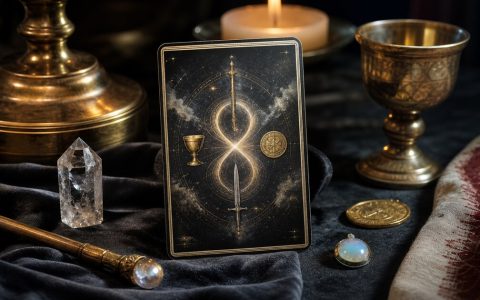
Four of Swords Tarot Card Meaning
The Four of Swords is the tarot’s card of rest, retreat, and recovery. In the Rider-Waite-Smith deck, it depicts a stone effigy of a knight lying on a tomb inside a church or chapel. Three swords hang on the wall above him, while a fourth lies horizontally beneath him, integrated into the tomb itself. A stained-glass window glows in the background, showing a figure offering blessings to a kneeling supplicant. The scene is one of absolute stillness, a sanctuary from the noise and conflict of the outside world, a sacred space where the body rests, the mind quiets, and the spirit recovers its strength.
Following the devastating heartbreak of the Three of Swords, the Four of Swords represents the necessary period of withdrawal and recuperation that follows intense emotional or mental pain. The battle has been fought. The wounds have been inflicted. Now the knight lays down his sword, retreats to sacred ground, and allows himself the time and space to heal. This is not weakness. This is the wisdom of knowing that a warrior who never rests eventually falls, that a mind that never quiets eventually breaks, and that recovery is not a luxury but a strategic necessity for anyone who wants to continue the journey.
In this comprehensive guide, you will explore every facet of the Four of Swords: its rich visual symbolism, upright and reversed meanings, its application to love, career, health, and spiritual questions, significant card combinations, and the practical wisdom this card offers for your tarot practice and daily life.
Four of Swords Card Description and Symbolism
The Four of Swords is one of the most visually peaceful cards in the entire tarot deck. After the turmoil of the Ace through Three of Swords, this card offers a moment of profound stillness. Every element in the image reinforces the themes of rest, sanctuary, and contemplative withdrawal.
The Recumbent Knight
The central figure is a knight carved in stone, lying in the traditional pose of a tomb effigy: hands clasped in prayer over his chest, body perfectly straight, eyes closed. This figure represents the querent in a state of intentional rest. The prayer position of his hands tells us that this is not ordinary sleep; it is a spiritual practice, a conscious withdrawal from the world for the purpose of communion with something higher. The knight has not been defeated. He has chosen to step back from the battle, to lay down his weapons, and to enter a state of receptive stillness.
The fact that the figure is carved in stone can be read in two ways. On one hand, it suggests deep, unshakeable peace, a stillness so profound that it resembles the permanence of stone. On the other hand, it can warn against the danger of becoming too rigid in your rest, of retreating so completely from life that you become, metaphorically, a stone figure, present but not alive. The Four of Swords walks a fine line between necessary rest and excessive withdrawal, and this dual symbolism reflects that tension.
The Three Hanging Swords
Three swords hang on the wall above the knight, their points directed downward toward his body. These three swords are the three worries, conflicts, or sources of mental anguish that have brought the knight to this place of rest. They are still present; the problems have not disappeared. They are, literally, hanging over him. But the knight has temporarily ceased to engage with them. He has put them on the wall, acknowledged their existence, and then turned his attention inward. This is the wisdom of the Four of Swords: you do not have to solve every problem right now. Sometimes the wisest thing you can do is set your problems aside and let your mind rest, knowing that you will return to them with renewed energy and a clearer perspective.
The Fourth Sword
The fourth sword lies horizontally beneath the knight, built into the tomb itself. This sword represents the one tool the knight takes with him into his rest: his inner clarity, his core truth, his essential self. While the three swords of external conflict hang above him, the fourth sword of internal truth supports him from below. This symbolism suggests that even in deep rest, a part of you remains alert, centered, and connected to your deepest knowing. Rest does not mean losing yourself. It means returning to yourself.
The Stained-Glass Window
A stained-glass window in the background depicts a scene of blessing, one figure extending grace to another who kneels in supplication. This window represents the sacred dimension of rest and retreat. The chapel setting tells us that the Four of Swords is not about collapsing in exhaustion; it is about intentionally creating sacred space for recovery. The stained glass filters light, transforming harsh sunlight into gentle, colored illumination. In the same way, the retreat represented by this card transforms the harsh light of external reality into something softer, more manageable, and more beautiful.
The religious imagery of the window also connects to traditions of monastic retreat, pilgrimage, and sabbatical, the ancient understanding that regular withdrawal from worldly activity is essential for spiritual health and mental clarity. Every major spiritual tradition includes some form of this practice: the Christian retreat, the Buddhist meditation vigil, the Jewish Shabbat, the Islamic period of reflection during Ramadan. The Four of Swords taps into this universal human need for periodic withdrawal and renewal.
Four of Swords Upright Meaning
When the Four of Swords appears upright in a reading, its message is simple and direct: you need rest. You have been through a difficult period, whether emotional, mental, physical, or all three, and your reserves are depleted. The card does not ask you to solve your problems right now. It asks you to step back from them temporarily so that you can recover the strength, clarity, and perspective needed to address them effectively when the time comes.
The Four of Swords upright often appears when someone has been pushing themselves too hard for too long. You may be burning the candle at both ends, running on adrenaline and caffeine, refusing to acknowledge your exhaustion because there is so much to do and so many people depending on you. The card gently but firmly tells you that this pace is not sustainable and that continuing to push without resting will eventually result in a collapse that is far more disruptive than a voluntary pause would be.
This card can also indicate a period of enforced rest, an illness, an injury, a job loss, or a circumstance that forces you to slow down whether you want to or not. If you have been ignoring your body’s signals, the Four of Swords can represent the universe stepping in and making the decision for you. In these cases, the card advises surrender rather than resistance. Your body or your circumstances are telling you something that your mind has been refusing to hear: you need to stop.
At its deepest level, the Four of Swords represents contemplation and meditation, the deliberate practice of quieting the mind so that deeper wisdom can surface. This is not passive rest but active inner work. It is the practice of stepping away from the noise of external life so that you can hear the quiet voice of internal truth. The answers you are seeking may not be found through more analysis, more discussion, or more research. They may be found in silence.
Four of Swords Reversed Meaning
When the Four of Swords appears reversed, the period of rest is ending. You are waking up, rising from the tomb, picking up your sword, and preparing to re-engage with the world. The reversed Four of Swords indicates the end of a retreat and the beginning of renewed activity. You have rested enough. You have recovered enough. It is time to return to the battle, refreshed and ready.
In some readings, the reversed Four of Swords warns against premature re-engagement. You may be getting restless during your recovery period, eager to get back to work or back to the fight before you have fully healed. The card in this position asks you to honestly assess whether you are truly ready or merely impatient. Returning to a stressful situation before you have fully recovered risks a relapse that will require an even longer period of rest. Honor your recovery process. Do not rush it.
Alternatively, the reversed Four of Swords can indicate an inability to rest. Perhaps your mind is too active to find peace, racing with anxiety, worry, or obsessive thoughts that prevent genuine relaxation. Perhaps your circumstances do not allow for rest: you have responsibilities that cannot be set aside, people who depend on you, or a financial situation that requires constant effort. In these cases, the reversed card acknowledges the difficulty of your situation while still emphasizing the importance of finding small pockets of rest wherever you can, even five minutes of quiet breathing, a short walk, or a few moments of mindful stillness can begin to restore a depleted system.
The reversed Four of Swords can also indicate isolation that has gone too far. What began as a healthy retreat has become unhealthy withdrawal. You are hiding from the world rather than resting within it. The sanctuary has become a prison. If you find yourself avoiding all social contact, canceling commitments, refusing to leave your home, or using rest as an excuse to avoid confronting your problems, the reversed Four of Swords may be telling you that it is time to open the door and step back out into the light.
Four of Swords in Love and Relationships
In love readings, the Four of Swords can indicate a period of quiet in a relationship, a lull in activity, a pause in communication, or a temporary separation that serves the purpose of allowing both partners to rest and reflect. This is not necessarily a negative sign. Healthy relationships require periods of quiet just as much as they require periods of passionate engagement. The Four of Swords in a love reading can represent a couple who has weathered a storm and is now resting in each other’s arms, not speaking, not planning, not problem-solving, just being still together.
However, this card can also indicate emotional withdrawal within a relationship. One or both partners may be pulling back, not out of spite or disinterest, but out of exhaustion. If your relationship has been through a period of intense conflict, the Four of Swords may appear to indicate that both parties need time to recover before they can productively discuss what happened. Give each other space. Do not force a conversation that neither of you has the energy for. The discussion will be more productive after both hearts have rested.
For single people, the Four of Swords often indicates a period of voluntary solitude, a break from dating, a hiatus from the search for a partner. After the heartbreak of the Three of Swords, this is a wise choice. Entering a new relationship while still carrying the wounds of the previous one is unfair to both you and your potential partner. Take the time you need. Heal your heart. Rebuild your sense of self. The right person will not be deterred by the fact that you took time to recover; they will be attracted by the wholeness and clarity that recovery provides.
In an existing relationship, the Four of Swords reversed can indicate that a period of distance or silence is ending and that communication and connection are about to be restored. It can also indicate restlessness within a relationship that has become too static, a desire for more excitement, more conversation, more engagement that signals it is time to break out of a rut and reinvest energy in the partnership.
Four of Swords in Career and Work
In career readings, the Four of Swords strongly advises taking a break from work. This could mean using your vacation days, taking a mental health day, reducing your hours, or, in more extreme cases, taking a leave of absence or a sabbatical. You have been working too hard, and the quality of your work is beginning to suffer as a result. Rest is not the enemy of productivity; it is its prerequisite. The most creative, innovative, and effective professionals are those who understand that the mind needs regular periods of downtime to consolidate learning, generate new ideas, and maintain the mental health necessary for sustained high performance.
The Four of Swords can also indicate a pause in career progress, a period where nothing seems to be happening professionally. Projects are on hold. Promotions are delayed. The job market is quiet. In these cases, the card advises patience and the productive use of downtime: pursue professional development, update your skills, clarify your career goals, or simply rest and recharge so that you are ready to seize opportunities when they arise.
For entrepreneurs and business owners, the Four of Swords can represent the strategic value of stepping back from day-to-day operations to gain perspective. When you are deeply embedded in the details of running a business, it is easy to lose sight of the bigger picture. A retreat, whether a week-long vacation or an afternoon spent in reflection, can provide the distance needed to see your business clearly and make strategic decisions from a place of clarity rather than exhaustion.
Four of Swords in Finances
Financially, the Four of Swords advises a conservative, quiet approach to money. This is not the time for bold investments, major purchases, or financial risk-taking. It is a time to let your money rest, to save rather than spend, to consolidate rather than expand. Your financial situation may be in a holding pattern, and the card advises you to accept this rather than trying to force growth during a period that is better suited to stability.
The Four of Swords can also indicate a need to step back from financial stress and anxiety. If money worries have been consuming your thoughts, the card advises you to give yourself a mental break from the constant calculation and worry. This does not mean ignoring your financial responsibilities; it means recognizing that obsessive worry about money is counterproductive and that a rested, clear mind makes better financial decisions than an anxious, exhausted one.
Reversed, the Four of Swords in finances can indicate a return to financial activity after a period of quiet, perhaps resuming investments, returning to work after a break, or re-engaging with financial planning after a period of avoidance or overwhelm.
Four of Swords in Health
The Four of Swords is one of the most important health cards in the tarot. Its message is unambiguous: your body needs rest. If you have been ill, the card stresses the importance of proper convalescence, not rushing back to activity before you have fully recovered. If you have been healthy but overworked, the card warns that your body is approaching its limits and that continued strain without adequate rest will result in illness, injury, or burnout.
This card often appears for people who have difficulty resting, type A personalities, caretakers who put everyone else’s needs before their own, or people who equate rest with laziness. The Four of Swords challenges these beliefs directly: rest is not laziness. Rest is essential biological maintenance. Your body cannot repair tissue, consolidate memory, regulate hormones, or maintain immune function without adequate sleep and downtime. Denying your body rest is not discipline; it is self-harm.
The Four of Swords can also indicate the value of mental health care, meditation, therapy, or mindfulness practices. The card’s emphasis on inner stillness and contemplation connects to the growing scientific evidence that practices like meditation and mindfulness have measurable positive effects on physical health, including reduced blood pressure, improved immune function, decreased inflammation, and enhanced emotional regulation.
Reversed in a health reading, the Four of Swords can indicate that a period of illness or recovery is ending and that you are ready to gradually resume normal activity. It can also warn against insomnia, anxiety-related sleep disturbances, or an inability to rest that is exacerbating health problems.
Four of Swords in Spirituality
Spiritually, the Four of Swords is a powerful call to contemplative practice. It represents the spiritual retreat, the meditation session, the silent prayer, the vision quest, any practice that involves withdrawing from the external world in order to deepen your connection with the internal or the divine. The chapel setting of the card explicitly connects this rest to sacred space and spiritual practice, suggesting that the rest you need is not just physical but also spiritual.
This card often appears when your spiritual practice has become too busy, too social, too intellectual, or too externally focused. Perhaps you have been reading too many spiritual books without putting their teachings into practice. Perhaps your spiritual life has become a performance rather than a genuine inner experience. The Four of Swords calls you back to the essence of spiritual practice: silence, stillness, and receptivity. Put down the books. Leave the workshop. Cancel the retreat that is really just a vacation with a spiritual label. Sit in a quiet room, close your eyes, and simply be present with whatever arises.
The Four of Swords can also indicate a period of spiritual dormancy, a time when your spiritual life feels flat, uninspired, or disconnected. The card assures you that this is normal and necessary. Seeds need time in the dark earth before they can sprout. Spiritual growth is not linear; it moves in cycles of activity and rest, expansion and contraction, revelation and integration. The quiet period is not a sign that you have lost your way; it is a sign that your inner self is integrating the growth that has already occurred, preparing the soil for the next phase of spiritual evolution.
Four of Swords: Yes or No
In a yes or no reading, the Four of Swords generally indicates not yet. The card’s energy is one of pause, delay, and waiting. The outcome you are asking about is likely to happen eventually, but not immediately. The timing is not right, and pushing for a result right now will be counterproductive. The card advises patience and trust in the process. Rest. Wait. Let things develop at their natural pace. The answer will become clear when the time is right.
If you are asking whether you should take a specific action, the Four of Swords advises waiting. This is not the time for bold moves. Gather your strength. Reflect on your options. Allow more information to emerge. Then act from a place of renewed clarity and energy rather than from a place of exhaustion and impulse.
Four of Swords in Combinations
Four of Swords and The Hermit
A powerful combination that strongly emphasizes solitude, introspection, and withdrawal from social life. Both cards advise going inward, and together they suggest a significant period of retreat that is deeply transformative. This combination often appears for people who are being called to a vision quest, a solo pilgrimage, or an extended period of solitary reflection.
Four of Swords and The Star
Healing is underway. The Star brings hope and gentle restoration, and alongside the Four of Swords, it promises that the period of rest will lead to genuine recovery and renewal. This is an excellent combination for those who are healing from illness, heartbreak, or trauma. Rest and hope working together are a powerful medicine.
Four of Swords and Eight of Wands
A tension between rest and activity. The Eight of Wands brings rapid movement and swift developments, which may be disrupting your attempt to rest. This combination can indicate that external events are pulling you back into action before you are ready, or that a period of rest is about to end abruptly as new developments demand your attention.
Four of Swords and Ten of Wands
Burnout. The Ten of Wands represents being overburdened, and the Four of Swords appears as the urgent prescription: put down the load. This combination often appears for people who are on the verge of physical or mental collapse from overwork. The message is unambiguous: you must rest, and you must rest now, before the Ten of Wands breaks your back.
Four of Swords and Death
A profound transformation is taking place during this period of rest. Death indicates major endings and new beginnings, and alongside the Four of Swords, it suggests that the rest you are experiencing is not idle but deeply transformative. You are not just recovering; you are being remade. The person who emerges from this retreat will be fundamentally different from the person who entered it.
Four of Swords as a Person
When the Four of Swords represents a person, it describes someone who values quiet, solitude, and inner peace above external stimulation and social activity. This person is the introvert, the contemplative, the deep thinker who needs regular periods of withdrawal to maintain their equilibrium. They are not antisocial, but they are selective about how they spend their social energy, and they require significant alone time to recharge after social interactions.
The Four of Swords person is often wise and thoughtful, someone who listens more than they speak, who observes more than they participate, and who processes life at a slower, more deliberate pace than the people around them. Their advice, when they offer it, tends to be measured and insightful, drawn from deep reflection rather than knee-jerk reaction. They may frustrate more action-oriented people with their seeming passivity, but those who understand them recognize that their stillness is not emptiness; it is depth.
This person may also be someone who is currently going through a difficult period and has withdrawn to heal. They may be dealing with illness, grief, burnout, or a crisis that requires them to step back from their usual roles and responsibilities. If the Four of Swords represents someone you are inquiring about, the card advises you to give them space and to trust that their withdrawal is temporary and necessary.
Four of Swords Timing
In timing questions, the Four of Swords indicates a period of waiting, typically around four days, four weeks, or four months. The suit of Swords is associated with the air element and the astrological signs of Gemini, Libra, and Aquarius. The Four of Swords is specifically linked to Jupiter in Libra, bringing themes of growth through balance, expansion through rest, and the blessings that come from allowing things to unfold in their own time.
The Four of Swords in timing suggests that the event or outcome you are asking about will happen after a period of rest or delay. It will not happen immediately, and trying to force it will be counterproductive. The best way to bring about the desired outcome is to stop trying so hard and let it come to you in its own time.
Four of Swords Advice
When the Four of Swords appears in the advice position, its counsel is clear and compassionate: rest. Stop pushing. Stop worrying. Stop trying to figure everything out. Step away from the situation that has been draining you and give yourself permission to be still. This is not giving up; this is strategic withdrawal for the purpose of renewal.
The card advises creating sacred space for your rest. This means more than just lying on the couch; it means intentionally carving out time and space for genuine recovery. Turn off your phone. Clear your schedule. Create an environment that supports stillness. Whether your sanctuary is a quiet room, a church, a forest, a bath, or a meditation cushion, find it and inhabit it fully. Let yourself be held by the silence.
The Four of Swords also advises you to trust that rest is productive. In a culture that glorifies busyness and equates worth with output, the idea of resting can trigger guilt and anxiety. The Four of Swords challenges this cultural programming directly: your value is not determined by your productivity. You are not a machine. You are a human being, and human beings need rest to function, to heal, to grow, and to create. The most productive thing you can do right now is nothing.
Finally, the card advises you to use this period of rest for reflection and contemplation. As you rest your body, let your mind gently sift through the experiences that brought you here. Do not analyze aggressively or obsess over problems. Simply let your mind wander, observe, and make connections at its own pace. The insights you need are already forming beneath the surface of your consciousness. Give them the quiet they need to emerge, and they will rise to meet you when the time is right.
For more card meanings and spreads, visit our complete tarot guide.