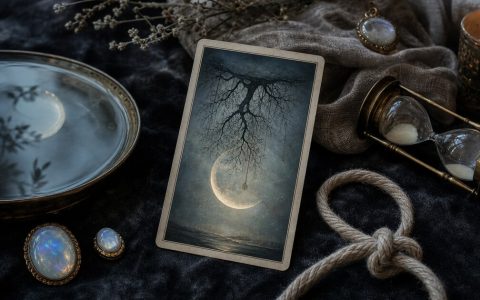
Two of Swords Tarot Card Meaning
The Two of Swords is one of the most visually striking and psychologically resonant cards in the Minor Arcana. In the Rider-Waite-Smith deck, it depicts a blindfolded woman seated on a stone bench at the edge of a body of water, holding two crossed swords over her chest. The moon, a thin crescent, hangs in the night sky behind her, and jagged rocks protrude from the water’s surface. Everything about this image communicates stasis, tension, and the uncomfortable suspension between two options. The woman cannot see, she has deliberately blocked her own vision, and the swords she holds are perfectly balanced, neither one outweighing the other. She is stuck. She is waiting. She is refusing to choose.
At its core, the Two of Swords is the card of indecision, denial, and the painful paralysis that comes when we are confronted with a choice we do not want to make. It represents a moment in life where the mind is divided, where two paths or two options seem equally valid or equally terrifying, and where the querent has responded to this dilemma by closing their eyes and pretending it does not exist. But the card also contains a deeper wisdom: the recognition that some decisions cannot be made with logic alone, that the mind has limits, and that true clarity sometimes requires us to remove the blindfold and trust a different kind of knowing.
In this comprehensive guide, you will explore the Two of Swords in all its dimensions: its visual symbolism, upright and reversed meanings, interpretations across love, career, health, and spirituality, its role in combinations with other cards, and practical advice for navigating the difficult crossroads this card represents in your tarot practice and daily life.
Two of Swords Card Description and Symbolism
The imagery of the Two of Swords is deceptively simple, but each element has been carefully chosen to express the card’s central theme of mental stalemate and willful avoidance.
The Blindfolded Woman
The central figure is a woman whose eyes are covered by a white blindfold. This is not blindness imposed from outside; it is self-imposed. She has chosen not to see. The blindfold represents the way we deliberately shut ourselves off from information, intuition, or uncomfortable truths when we are afraid of what a decision might cost us. She is not ignorant of the choice before her. She knows it exists. She simply cannot bear to look at it directly, because looking means choosing, and choosing means losing one of the two things she is trying to hold onto simultaneously.
The white color of the blindfold connects to themes of purity and innocence, suggesting that the woman’s avoidance is not malicious but self-protective. She is trying to maintain her peace, her equilibrium, her sense of safety in a situation that threatens all three. But the card gently reminds us that peace purchased through denial is not real peace. It is a ceasefire, not a resolution, and it can only last so long before the underlying conflict demands attention.
The Crossed Swords
The woman holds two long swords crossed over her chest in a defensive posture. The swords are perfectly balanced, reflecting the equal weight of the two options she faces. Neither sword is heavier, longer, or more prominent than the other, because in her mind, neither option has a clear advantage. The crossed position also creates a barrier over her heart, suggesting that she is using intellectual analysis and rationalization to protect herself from emotional vulnerability. She is thinking her way around a problem that may ultimately require feeling.
The swords also represent the two sides of an argument, two perspectives, two truths that seem equally valid and equally irreconcilable. The Two of Swords often appears when someone is caught between two people, two belief systems, two life paths, or two versions of reality that cannot both be true. The crossed swords show that the querent is holding both truths simultaneously, and the strain of doing so is becoming unbearable.
The Crescent Moon
A thin crescent moon hangs in the sky behind the woman, casting minimal light on the scene. The moon is the symbol of intuition, the unconscious, and the emotional realm. Its presence here is significant: even though the woman has blindfolded herself and is relying on logic (the swords) to navigate her dilemma, the moon reminds us that intuition is available to her if she chooses to access it. The crescent phase suggests that this intuitive knowledge is still emerging, still growing, not yet full. The answers the woman seeks are developing beneath the surface of her consciousness, but she has not yet allowed them to fully form.
The moon also governs cycles and tides, suggesting that the situation depicted in the Two of Swords is not permanent. Like all lunar phases, this phase of indecision will pass. The tide will turn. The moon will wax full, and clarity will come whether the woman seeks it or not. The only question is whether she will choose her direction before circumstances choose for her.
The Rocky Water
Behind the woman, a body of water stretches to the horizon, its surface broken by jagged rocks or small islands. Water represents emotion and the unconscious, while the rocks represent the hidden obstacles, complications, and painful truths that lurk beneath the surface of the situation. The woman has her back to the water; she is literally turned away from her emotions, facing away from the depths that might give her insight. The rocks warn that the emotional landscape of this decision is treacherous and that navigating it will require care, but they also suggest that there are solid footholds available if she is willing to look for them.
The Stone Bench
The woman sits on a stone bench, a symbol of rigidity, permanence, and resistance to change. She has planted herself firmly in this position of indecision, and she is not inclined to move. The stone suggests that her avoidance has calcified into a habit, a default response to difficulty. She is not actively deciding not to decide; she has simply become accustomed to this posture of stasis, and movement in any direction now feels impossible. The bench is also elevated slightly, placing her above the ground level, which can suggest intellectual detachment, viewing the situation from a theoretical distance rather than engaging with it on the ground.
Two of Swords Upright Meaning
When the Two of Swords appears upright in a reading, it signals that you are facing a difficult choice and have responded by refusing to choose. You are in a state of mental stalemate, paralyzed between two options that both carry significant consequences. The card does not judge you for this paralysis; it acknowledges that the decision before you is genuinely difficult and that neither option is clearly superior to the other. But it also makes clear that avoidance is not a sustainable strategy and that the decision will eventually need to be made.
The Two of Swords upright often appears when you are in denial about something. You know, on some level, what the right choice is, but you do not want to face the implications. Perhaps choosing one path means abandoning another. Perhaps making a decision requires admitting something uncomfortable about yourself, your situation, or someone you love. Perhaps you are afraid that choosing wrong will be worse than not choosing at all. The card gently challenges this assumption: in almost every case, the pain of sustained indecision is greater than the pain of a wrong choice, because wrong choices can be corrected, but paralysis only deepens over time.
This card can also indicate a truce or a temporary peace in a conflict. Two opposing forces have agreed to stand down, but the underlying issues have not been resolved. This is a ceasefire, not a peace treaty. The swords are still drawn, still held at the ready. The moment the truce breaks, the conflict will resume with all its original intensity. If you are experiencing a period of calm in an otherwise turbulent situation, the Two of Swords warns you not to mistake this calm for resolution. The real work of addressing the root cause of the conflict still needs to be done.
At its most positive, the Two of Swords can indicate a necessary period of contemplation before a major decision. Not all hesitation is avoidance; sometimes the wise course of action is to gather more information, consult your inner wisdom, and allow clarity to emerge naturally before committing to a path. If you are genuinely in a period of thoughtful deliberation rather than anxious paralysis, the Two of Swords can validate your approach while reminding you that deliberation must eventually give way to action.
Two of Swords Reversed Meaning
When the Two of Swords appears reversed, the blindfold is coming off. Information that was previously hidden, denied, or avoided is now coming to light, and the querent can no longer maintain their position of willful ignorance. The truth is emerging, and with it comes the necessity of making the decision that has been postponed.
The Two of Swords reversed can indicate that the stalemate is finally breaking. External events, new information, or an internal shift in perspective is disrupting the precarious balance that the querent had been maintaining. This can feel simultaneously liberating and terrifying. The comfort of indecision, however uncomfortable, was at least familiar. Now the querent is being thrust into the unfamiliar territory of having to choose, and the responsibility of that choice feels overwhelming.
In some readings, the reversal indicates that the querent is being flooded with too much information, making the decision even more confusing than before. Where the upright card showed a deliberate blocking of information, the reversal can swing to the opposite extreme: information overload, conflicting advice from too many sources, analysis paralysis driven by too many variables rather than too few. In this case, the card advises simplification. Strip away the noise. Return to your core values. Ask yourself what you truly want, not what logic dictates or others expect.
The Two of Swords reversed can also indicate dishonesty or deception being revealed. Someone may have been withholding information from you, or you may have been withholding information from yourself. Secrets, lies, or uncomfortable truths are surfacing, and while the revelation may be painful, it provides the clarity needed to move forward. The truth, however unwelcome, is always better than the false peace of ignorance.
In relationship contexts, the reversed Two of Swords often signals the end of avoidance in a partnership. A conversation that has been postponed is finally happening. A truth that has been suppressed is finally being spoken. This can be the breakthrough moment that either heals the relationship or confirms that it needs to end, but either outcome is preferable to the ongoing stagnation of the upright position.
Two of Swords in Love and Relationships
In love readings, the Two of Swords speaks directly to emotional standoffs, avoided conversations, and the paralysis that comes from being caught between two romantic options or between staying and leaving a relationship. This card frequently appears when someone is trying to maintain a relationship while simultaneously knowing, on a level they refuse to acknowledge, that something is fundamentally wrong.
For those in relationships, the Two of Swords often indicates a couple at an impasse. There is a significant issue that both partners are aware of but neither is willing to address directly. This could be a difference in values, a conflict about the future, an act of betrayal that has been swept under the rug, or a fundamental incompatibility that both partners have agreed, silently, to ignore. The card warns that this avoidance is eroding the relationship from within, like termites in the walls of a house that looks solid from the outside. The longer the conversation is postponed, the more damage is done.
For single people, the Two of Swords can indicate being caught between two potential partners, two approaches to dating, or two conflicting desires regarding love. Perhaps you want intimacy but fear vulnerability. Perhaps you are attracted to someone who represents stability and simultaneously drawn to someone who represents excitement. The card does not tell you which option is correct; it tells you that you need to make a choice rather than continuing to hover between possibilities, because hovering prevents you from fully engaging with either.
The Two of Swords in love can also represent emotional guardedness. The crossed swords over the heart are a powerful image of self-protection, and in romantic contexts, this protection may be the querent’s primary obstacle. Past heartbreak has taught them to approach love with a defensive posture, and while this defense successfully prevents further pain, it also prevents genuine connection. The card asks whether the safety of emotional walls is worth the loneliness they create.
When this card appears reversed in a love reading, it often signals that the walls are finally coming down. A difficult but necessary conversation is happening. A choice between partners is being made. An emotional truth is being spoken. The reversed Two of Swords in love is often a catalyst moment, the instant when the relationship either deepens through honest confrontation or ends because the truth, once spoken, cannot be unspoken.
Two of Swords in Career and Work
In career readings, the Two of Swords represents professional indecision, often a crossroads between two job offers, two career paths, two projects, or two fundamentally different approaches to your professional life. You may be weighing the security of a stable but uninspiring position against the risk and excitement of an entrepreneurial venture. You may be choosing between two departments, two clients, two business models, or two professional identities. The card indicates that you have analyzed the options thoroughly and that additional analysis is unlikely to produce a clear winner. At some point, you must simply choose.
This card can also appear when there is a conflict at work that no one wants to address. Perhaps there is tension between team members, a disagreement about strategy, or a problem with leadership that everyone acknowledges privately but no one is willing to raise publicly. The Two of Swords in a career context often represents the corporate equivalent of the elephant in the room: everyone can see it, but a tacit agreement to pretend it does not exist keeps the uncomfortable peace intact. The card warns that this peace is temporary and that the unaddressed issue will eventually disrupt the entire team or organization.
For business owners, the Two of Swords can indicate a strategic stalemate with a competitor, a partnership where both parties have different visions, or a market condition that makes it impossible to determine the best course of action. The card advises that while caution is appropriate, indefinite hesitation is costly. In business, the opportunity cost of inaction often exceeds the risk of an imperfect action.
Two of Swords in Finances
Financially, the Two of Swords indicates a period of monetary stagnation driven by indecision. You may be paralyzed between saving and investing, between paying down debt aggressively and maintaining a cash reserve, between a conservative financial strategy and a more aggressive one. The card suggests that your financial situation is stable but stagnant, and that it will remain so until you commit to a direction.
This card can also appear when you are avoiding looking at your finances altogether. The blindfold in financial readings is particularly apt: many people literally refuse to look at their bank statements, credit card bills, or retirement accounts because the numbers provoke anxiety. The Two of Swords warns that financial avoidance always makes things worse. Whatever the numbers say, knowing them gives you power. Not knowing them gives fear the power instead.
In some readings, the Two of Swords in finances can indicate a financial dispute or negotiation that has reached a stalemate. Neither party is willing to compromise, and both are holding their positions rigidly. The card advises that compromise, while never perfectly satisfying to either side, is almost always preferable to the ongoing costs of an unresolved financial dispute.
Two of Swords in Health
In health readings, the Two of Swords often points to the mental and emotional dimensions of physical health. Stress, anxiety, and the psychological toll of unresolved decisions can manifest in the body as tension headaches, jaw clenching, shoulder and neck pain, insomnia, and digestive issues. The card suggests that your physical symptoms may be connected to the mental state of chronic indecision or avoidance, and that addressing the psychological root cause may be as important as treating the physical symptoms.
The Two of Swords in health can also indicate a situation where you are avoiding a medical consultation, test, or diagnosis. You may suspect that something is wrong but prefer the uncertainty of not knowing to the potential certainty of a diagnosis. The card strongly advises against this avoidance. Medical information, like all information, gives you power and options. Ignorance does not prevent illness; it only prevents treatment.
This card can sometimes appear when a person is choosing between two treatment approaches, two doctors, or two health philosophies. The card does not indicate which option is better, but it encourages the querent to make a decision and commit to it rather than vacillating between approaches, which can undermine the effectiveness of both.
Two of Swords in Spirituality
Spiritually, the Two of Swords represents a crisis of discernment. You may be caught between two belief systems, two spiritual practices, two teachers, or two versions of truth that seem incompatible. The card speaks to the genuine difficulty of navigating spiritual questions where certainty is impossible and where the intellect, no matter how sharp, cannot cut through the mystery.
The blindfold in spiritual readings takes on an additional meaning. While it can represent willful ignorance, it can also represent the mystical concept of seeing beyond the physical, of closing the outer eyes in order to open the inner eye. Some traditions teach that the deepest truths can only be perceived when the rational mind is quieted and the intuitive mind is allowed to speak. In this light, the Two of Swords can indicate a period of spiritual gestation, a time when you are called to sit in the darkness, hold the tension of not knowing, and trust that clarity will emerge in its own time.
The Two of Swords reversed in spiritual readings often indicates a spiritual breakthrough, a moment when the blindfold falls away and you suddenly see your path with clarity. This moment of revelation may be triggered by a book, a teacher, a dream, a synchronicity, or simply the natural unfolding of your spiritual development. When it comes, trust it. The clarity you have been seeking has arrived, and it is time to act on it.
Two of Swords: Yes or No
In a yes or no reading, the Two of Swords is generally interpreted as a no, or more accurately, as a not yet. The card’s fundamental energy is one of stalemate, indecision, and blocked progress. It suggests that the situation in question has not yet resolved itself and that a definitive answer is not available at this time. The forces at play are too evenly balanced, the information is too incomplete, or the querent’s own ambivalence is preventing a clear outcome from manifesting.
If you receive the Two of Swords in a yes or no reading, the most useful interpretation is that the answer depends on a decision you have not yet made. The outcome is not predetermined; it is waiting for you to act. Once you make the choice you have been avoiding, the situation will begin to move, and a clearer answer will emerge. In this sense, the Two of Swords in a yes or no reading is not giving you an answer; it is telling you that the answer is in your hands.
Two of Swords in Combinations
The Two of Swords takes on different dimensions depending on which cards appear alongside it. Here are some of the most significant combinations.
Two of Swords and The High Priestess
This combination powerfully reinforces the theme of hidden knowledge and the need to trust intuition. The High Priestess guards the mysteries, and together with the Two of Swords, she suggests that the answer to your dilemma exists in your subconscious. You already know what to do; you need to go inward and listen to the wisdom that lies beyond rational analysis. Meditation, dreamwork, and quiet contemplation are the paths forward.
Two of Swords and The Tower
A dramatic combination that warns the querent: if you do not make the decision voluntarily, it will be made for you by circumstances beyond your control. The Tower brings sudden, dramatic change that demolishes the structure of avoidance. The Two of Swords is the calm before The Tower’s storm. Together, these cards are an urgent warning to act now, before the universe acts for you in a way that may be far more disruptive than any choice you could have made on your own.
Two of Swords and Justice
This pairing connects your indecision to questions of fairness, ethics, and consequences. Justice demands that a balanced and equitable decision be made, and the Two of Swords shows that you are struggling to determine what fairness looks like in this situation. Together, these cards advise you to set aside personal preferences and emotional attachments and instead focus on what is objectively right. The fair choice is the correct choice, even if it is not the easy one.
Two of Swords and The Moon
When The Moon accompanies the Two of Swords, confusion deepens. Illusions, fears, and subconscious projections are clouding your judgment, making the decision even more difficult. This combination warns against making choices based on fear or fantasy. Wait until the fog lifts. Seek clarity through honest self-examination and trusted counsel before committing to a direction.
Two of Swords and Six of Cups
This combination suggests that your indecision is rooted in the past. Nostalgia, childhood patterns, or unresolved experiences from your history are influencing your current inability to choose. The Six of Cups asks you to examine how your past is shaping your present paralysis and whether the memories you are clinging to are helping or hindering your ability to move forward.
Two of Swords and Ace of Wands
A hopeful combination. The Ace of Wands brings a burst of creative energy and new inspiration that can break through the stalemate of the Two of Swords. A new idea, a flash of passion, or an unexpected opportunity may arrive that makes the choice suddenly clear. Stay open to inspiration from unexpected sources.
Two of Swords as a Person
When the Two of Swords represents a person in a reading, it describes someone who is deeply conflicted, intellectually sharp but emotionally guarded, and prone to analysis paralysis. This person is the chronic overthinker, the one who creates spreadsheets of pros and cons for every decision, who researches endlessly but never commits, who can argue both sides of any issue with equal conviction and therefore never lands firmly on either side.
The Two of Swords person is often highly intelligent and articulate. They are excellent at seeing multiple perspectives, which makes them fair-minded and empathetic, but it also makes them maddeningly indecisive. They can spend hours, days, or even years deliberating over choices that others would make in minutes. Their fear is not of making the wrong decision but of making any decision, because every choice closes a door, and they want all doors to remain open.
Emotionally, the Two of Swords person tends to be guarded. They process life through their intellect rather than their emotions, and they can appear cold or detached to those who do not understand that their detachment is a defense mechanism rather than an inherent personality trait. Beneath the blindfold and the crossed swords, there is often a deeply sensitive person who has learned that feeling too much is dangerous and that the mind offers a safer refuge than the heart.
In relationships, this person can be frustrating to love. They struggle with commitment because commitment requires choosing one person and thereby unchosen others. They avoid conflict because conflict requires taking a position. They may love deeply but express it cautiously, always holding something back, always keeping one foot out the door, not because they do not care but because caring feels like the most dangerous thing in the world.
Two of Swords Timing
When the Two of Swords appears in a timing question, it often indicates delays and stagnation. The situation you are asking about is currently in a holding pattern, and movement is unlikely until a decision is made or new information emerges. In terms of specific timing, the Swords suit is associated with the element of Air and the astrological signs of Gemini, Libra, and Aquarius. The Two of Swords is specifically linked to the Moon in Libra, which reinforces themes of emotional balance, relational harmony, and the desire to avoid conflict at all costs.
In terms of calendar timing, the Two of Swords can point to a period of approximately two weeks or two months, reflecting the number two. It can also indicate that two key pieces of information or two critical events need to occur before the situation can resolve. The card’s fundamental message regarding timing is patience combined with readiness: the situation will move when it is ready, but you must be prepared to act when it does, or the moment of opportunity may pass.
Two of Swords Advice
When the Two of Swords appears in the advice position of a reading, its message is both compassionate and firm: acknowledge that you are stuck, understand why you are stuck, and then take steps to get unstuck. The card does not demand that you make your decision immediately, but it does insist that you stop pretending that indecision is the same as wisdom and that avoidance is the same as peace.
The Two of Swords advises you to remove the blindfold. Look at the situation directly, with all its complexity and discomfort. Gather the information you have been avoiding. Have the conversation you have been postponing. Face the truth you have been denying. Yes, it will be uncomfortable. Yes, it may be painful. But the discomfort of truth is acute and temporary, while the discomfort of avoidance is chronic and cumulative.
The card also advises you to recognize the limits of intellectual analysis. You have been thinking about this decision extensively, and thinking has not produced clarity. This is because the decision may not be a thinking problem; it may be a feeling problem, a values problem, or a courage problem. Put down the swords. Close the spreadsheet. Stop asking other people for their opinions. Go somewhere quiet, place your hand on your heart, and ask yourself what you already know. The Two of Swords, despite its depiction of confusion, often appears when the querent already knows the answer but is afraid to admit it. Your heart has already decided. Your mind is simply taking longer to catch up.
Finally, the Two of Swords advises you to accept that every choice involves loss. You cannot have everything. You cannot keep every door open. Choosing one path means not choosing another, and that is not a tragedy; it is the fundamental structure of a meaningful life. A life where every option remains permanently open is a life where nothing is ever fully experienced, fully committed to, or fully loved. The Two of Swords invites you to trade the anxious freedom of indecision for the grounded freedom of commitment. Choose. Accept the consequences. And then walk forward without looking back, trusting that the path you have chosen is the one your soul needed, even if your mind is not yet convinced.
For more card meanings and spreads, visit our complete tarot guide.