The 12 Houses in Astrology: What Each House Represents
If the zodiac signs describe how energy expresses itself and the planets describe what kind of energy is at work, then the houses describe where that energy plays out in your life. The twelve houses of the astrological chart divide the sky into twelve sectors, each corresponding to a specific domain of human experience — from identity and finances to relationships, career, and spirituality. Understanding the houses is essential for moving beyond Sun sign astrology and reading your full natal chart with depth and precision.
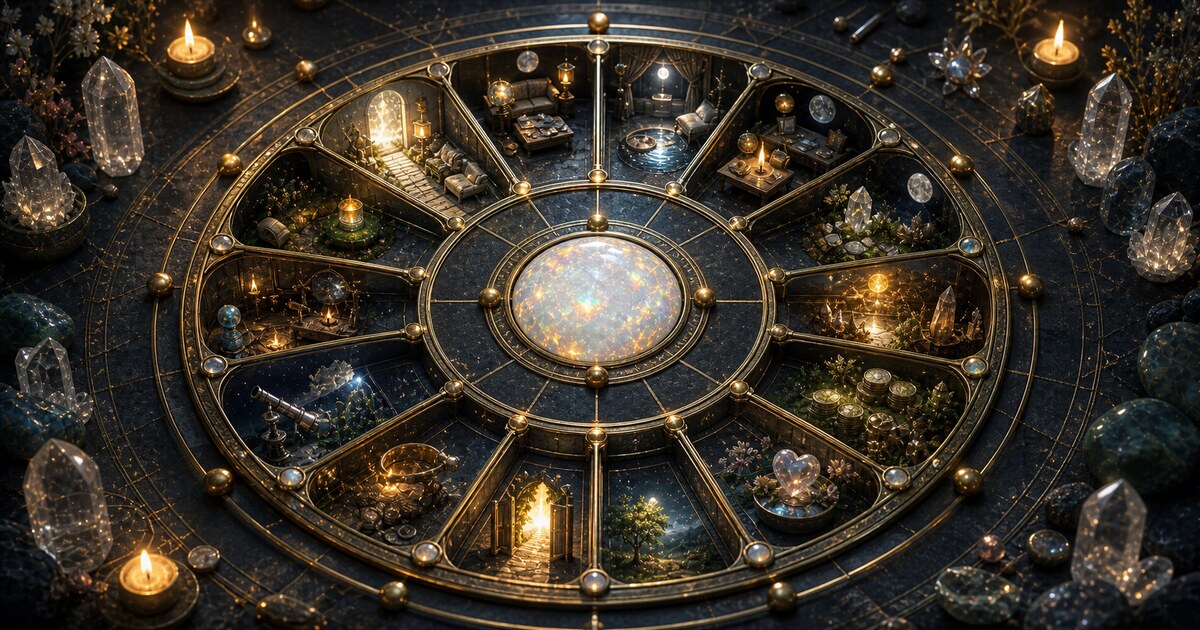
When you look at a natal chart, you see a circle divided into twelve pie-shaped sections. These are the houses. Each house begins at a point called the house cusp, which falls in a specific zodiac sign. The sign on the cusp colors the way you experience that life domain, while any planets located within the house bring additional energy and focus to that area. Houses with multiple planets are especially active and complex areas of life, while empty houses operate more quietly in the background.
In this guide, you will learn what each of the twelve houses represents, how planets in houses work, what empty houses mean, and how different house systems affect your chart. Whether you are a beginner looking to understand your first natal chart or an intermediate student ready to deepen your knowledge, this article will give you a thorough grounding in one of astrology’s most important building blocks.
What Are Houses in Astrology?
The houses are a division of the local sky into twelve sectors based on the rotation of the Earth. Unlike the zodiac signs, which are based on the apparent path of the Sun through the sky over the course of a year (the ecliptic), the houses are based on the Earth’s daily rotation — specifically, on the relationship between the horizon and the meridian at your birth location and time.
The starting point for the house system is the Ascendant, the degree of the zodiac rising over the eastern horizon at the moment of birth. This becomes the cusp of the first house. From there, the houses proceed counterclockwise around the chart, each one governing a progressively different area of life. The Ascendant determines the entire house layout, which is why your Rising sign is so important — it sets the stage for the entire chart.
The houses can be thought of as the stage on which the drama of your life unfolds. The planets are the actors, the signs are the costumes and attitudes, and the houses are the settings — the rooms, landscapes, and arenas where the action takes place. A planet’s house placement tells you in which area of life that planetary energy will be most keenly felt.
House Classification: Angular, Succedent, and Cadent
The twelve houses are grouped into three categories of four based on their relationship to the chart angles:
- Angular Houses (1st, 4th, 7th, 10th) — These are the most powerful positions in the chart, located at the four cardinal points (Ascendant, IC, Descendant, Midheaven). Planets in angular houses are prominent, visible, and active in your life. They represent areas where you take initiative and where your actions have the most direct impact.
- Succedent Houses (2nd, 5th, 8th, 11th) — These follow the angular houses and represent areas of stabilization, resources, and consolidation. Planets in succedent houses are strong but less immediately visible than angular planets. They represent the resources and support systems you build in response to the angular house initiatives.
- Cadent Houses (3rd, 6th, 9th, 12th) — These are the transitional houses, associated with learning, adaptation, and preparation. Planets in cadent houses are more mental or internal in their expression. They represent areas of processing, understanding, and refining experience before the next angular house begins a new cycle of action.
House Systems: Placidus, Whole Sign, and Others
One of the areas where astrologers disagree most strongly is the question of which house system to use. There are dozens of house systems, each using a different mathematical method to divide the sky into twelve sections. The two most popular in modern astrology are Placidus and Whole Sign.
Placidus House System
Placidus is the most widely used house system in Western astrology today, partly because it has been the default in most astrological software and textbooks for the past several decades. It divides the sky based on the time it takes for each degree of the ecliptic to move from the Ascendant to the Midheaven. This creates houses of unequal size, meaning some houses can be very large while others are quite small, depending on the birth latitude and time.
Placidus works well for most births, but it can produce distorted results at extreme northern or southern latitudes, where some signs may never rise or set, creating “interception” — a situation where a sign is entirely contained within a house without appearing on any house cusp.
Whole Sign House System
Whole Sign houses are the oldest house system in Western astrology, dating back to the Hellenistic period. In this system, the entire sign that contains the Ascendant becomes the first house, the next sign becomes the second house, and so on. Every house is exactly 30 degrees (one complete sign), and there are no interceptions or unequal house sizes.
Whole Sign houses have experienced a major revival in recent years, particularly among traditional astrologers. Advocates appreciate their simplicity, historical pedigree, and the clarity they bring to chart interpretation. Critics argue that they lose some of the nuance that quadrant-based systems like Placidus provide, particularly around the Midheaven and IC, which may not fall on the 10th and 4th house cusps in Whole Sign.
Other House Systems
Other notable house systems include Koch (popular in German-speaking countries), Equal House (each house is exactly 30 degrees starting from the Ascendant degree, but unlike Whole Sign, the houses do not correspond to complete signs), Campanus, Regiomontanus, and Porphyry. Each has its own mathematical logic and its passionate defenders. Most astrologers recommend experimenting with different systems and seeing which one produces interpretations that resonate most strongly with your lived experience.
The 12 Houses: A Complete Guide
The First House: Self, Identity, and Physical Body
Natural ruler: Aries | Planetary association: Mars | Type: Angular
The first house is the house of self. It begins at the Ascendant and represents your identity, physical body, appearance, temperament, and the way you instinctively approach life. It is the most personal house in the chart, and planets here are among the most visible and influential in shaping who you are and how others perceive you.
The sign on the first house cusp is your Rising sign, and it sets the tone for your entire chart. Planets in the first house add additional layers to your personality and can significantly modify the impression you make. For example, someone with Libra rising but Mars in the first house will come across as more assertive and dynamic than the typical gracious Libra rising impression might suggest.
First house themes include: self-image, physical appearance, body language, first impressions, personal initiative, how you begin things, your default approach to new situations, and your overall vitality and health constitution.
The Second House: Finances, Values, and Self-Worth
Natural ruler: Taurus | Planetary association: Venus | Type: Succedent
The second house governs your relationship with money, material possessions, personal resources, and self-worth. It describes how you earn, spend, save, and value material things. But it goes deeper than just finances — the second house is fundamentally about what you value, what gives you a sense of security, and what resources (material, psychological, and talent-based) you bring to the table.
Planets in the second house focus attention and energy on matters of income, possessions, and self-esteem. Jupiter here often indicates financial abundance or a generous attitude toward money. Saturn here can suggest financial challenges in early life that lead to disciplined money management later. Venus here loves luxury and beauty in their material environment.
Second house themes include: income and earning ability, spending habits, possessions, material security, personal values, self-esteem, natural talents and resources, relationship with food and physical comfort.
The Third House: Communication, Learning, and Siblings
Natural ruler: Gemini | Planetary association: Mercury | Type: Cadent
The third house governs communication, short-distance travel, early education, siblings, neighbors, and the immediate environment. It describes how you think, how you process and share information, and how you interact with the people and places in your daily surroundings. It is a busy, mentally active house associated with curiosity, learning, and the exchange of ideas.
Planets in the third house amplify communication abilities and mental interests. Mercury here is in its natural domain and can indicate exceptional verbal or writing ability. Mars here can make communication forceful or argumentative. Neptune here can produce imaginative, poetic thinking but also confusion in practical communication.
Third house themes include: speaking and writing, learning style, short trips, siblings and sibling relationships, neighbors, local community, early schooling, mental agility, multitasking, everyday social interactions.
The Fourth House: Home, Family, and Roots
Natural ruler: Cancer | Planetary association: Moon | Type: Angular
The fourth house is one of the four angular houses and is located at the very bottom of the chart, at the IC (Imum Coeli). It represents your home, family of origin, ancestry, emotional foundations, and the most private areas of your life. It describes where you come from, the emotional atmosphere of your childhood home, and what kind of home and domestic life you create for yourself as an adult.
The fourth house also represents the end of matters — how things conclude, the final years of life, and the legacy you leave behind. Planets here are deeply personal and often connected to family patterns, ancestral inheritance (psychological and sometimes material), and the need for a secure home base.
Fourth house themes include: home and living situation, family of origin, mother or nurturing parent, ancestry and heritage, emotional security, private life, real estate, psychological foundations, endings and conclusions.
The Fifth House: Creativity, Romance, and Joy
Natural ruler: Leo | Planetary association: Sun | Type: Succedent
The fifth house is the house of creative self-expression, romance, pleasure, children, and all forms of play and enjoyment. It represents what you do for fun, how you express your creativity, your approach to dating and romance (as distinct from committed partnership, which belongs to the seventh house), and your relationship with children — both your own and children in general.
This is one of the most joyful houses in the chart, associated with the things that make life worth living beyond mere survival and duty. Planets here bring energy and focus to creative pursuits, romantic adventures, and the experience of pleasure. The Sun here is in its natural domain and often indicates a person with strong creative drives and a love of being the center of attention. Venus here brings romance, artistic talent, and a love of beauty and entertainment.
Fifth house themes include: creative expression, artistic endeavors, hobbies, romantic affairs, dating, courtship, children, pregnancy, gambling and speculation, entertainment, sports, fun, and what brings you joy.
The Sixth House: Health, Work, and Daily Routines
Natural ruler: Virgo | Planetary association: Mercury | Type: Cadent
The sixth house governs your daily work, health habits, routines, service to others, and relationship with employees or coworkers. Unlike the tenth house, which governs career and public reputation, the sixth house is about the day-to-day grind — your work environment, your daily schedule, your approach to tasks and chores, and your physical health maintenance.
This is also the house of service — not just employment but the impulse to be useful, to help, to improve, and to contribute to the functioning of the world around you. Planets here bring focus to matters of health, work efficiency, and practical service. Saturn here can indicate health challenges that require disciplined self-care or a work environment that feels restrictive. Jupiter here often brings a positive work environment and good health fortune.
Sixth house themes include: daily work and employment, health and wellness, exercise and diet, daily routines and habits, service to others, coworkers, pets, efficiency, organization, self-improvement, and relationship with the physical body.
The Seventh House: Partnership, Marriage, and Contracts
Natural ruler: Libra | Planetary association: Venus | Type: Angular
The seventh house sits directly opposite the first house, and while the first house represents the self, the seventh house represents the other. It governs committed partnerships (marriage, business partnerships, and any formalized one-on-one relationship), open enemies, legal matters, and the qualities you seek in a partner. This is an angular house, making it one of the most powerful and publicly visible areas of the chart.
One of the most fascinating dynamics of the seventh house is the phenomenon of projection. The sign on the seventh house cusp (always opposite your Rising sign) often represents qualities you do not easily express yourself but are strongly attracted to in others. You may unconsciously seek partners who embody these qualities, for better or worse. Understanding your seventh house can help you become more conscious about what you attract in relationships and why.
Seventh house themes include: marriage and committed partnerships, business partnerships, contracts and agreements, open enemies, lawsuits and legal matters, the qualities you seek in a partner, how you behave in one-on-one relationships, synastry and compatibility dynamics.
The Eighth House: Transformation, Shared Resources, and Intimacy
Natural ruler: Scorpio | Planetary association: Pluto (modern), Mars (traditional) | Type: Succedent
The eighth house is one of the most complex and misunderstood houses in astrology. It governs transformation, death and rebirth (metaphorical and literal), shared resources (other people’s money, inheritance, taxes, debt), deep emotional intimacy, sexuality (as a merging experience rather than a pleasure pursuit, which is fifth house), and the occult or hidden dimensions of life.
This house represents the areas of life where you must let go of control, merge with something or someone beyond yourself, and undergo profound transformation. It is not comfortable territory, but it is where the deepest growth occurs. Planets in the eighth house indicate areas of life where you experience intense transformation, confrontations with power dynamics, and the need to surrender and regenerate.
Eighth house themes include: shared finances, inheritance, taxes, debt, insurance, deep emotional bonds, sexual intimacy, death and dying, psychological transformation, the occult and esoteric studies, power dynamics, crisis and regeneration, research and investigation.
The Ninth House: Philosophy, Travel, and Higher Learning
Natural ruler: Sagittarius | Planetary association: Jupiter | Type: Cadent
The ninth house governs higher education, long-distance travel, philosophy, religion, spirituality, law, publishing, and the search for meaning and truth. While the third house (its opposite) deals with concrete facts, immediate communication, and short trips, the ninth house expands outward to the big picture — the overarching beliefs, worldview, and quest for understanding that give your life a sense of purpose and direction.
Planets in the ninth house bring energy and focus to the search for meaning. Jupiter here is in its natural home and often indicates a lifelong learner, traveler, or philosopher. Saturn here can suggest a more disciplined or skeptical approach to belief, or challenges in higher education that ultimately lead to deep wisdom. Mercury here produces a mind that craves intellectual breadth and loves to learn about foreign cultures, languages, or philosophical systems.
Ninth house themes include: university education, advanced degrees, long-distance and international travel, foreign cultures and languages, philosophy and ethics, religion and spirituality, the legal system, publishing and broadcasting, teaching and mentoring, the search for truth and meaning.
The Tenth House: Career, Reputation, and Public Image
Natural ruler: Capricorn | Planetary association: Saturn | Type: Angular
The tenth house, located at the very top of the chart at the Midheaven (MC), is the house of career, public reputation, achievement, social status, and the mark you leave on the world. This is the most publicly visible house in the chart, and planets here are often strongly connected to your professional life and the way society perceives you. It is an angular house, making it one of the four most powerful positions in the chart.
The sign on the Midheaven (tenth house cusp) describes the qualities you project in your professional life and the kind of career or public role that suits you. Planets in the tenth house bring their energy directly into your professional sphere. The Sun here often indicates a strong drive for public recognition and leadership. Saturn here suggests a career built slowly through hard work and discipline. Mars here can indicate an ambitious, competitive approach to career advancement.
Tenth house themes include: career and profession, public reputation, social status, achievement and ambition, authority figures, the father or authoritative parent, government and institutions, your contribution to society, legacy and public recognition.
The Eleventh House: Community, Friendships, and Hopes
Natural ruler: Aquarius | Planetary association: Uranus (modern), Saturn (traditional) | Type: Succedent
The eleventh house governs friendships, social groups, community involvement, collective goals, humanitarian causes, and your hopes and wishes for the future. While the fifth house (its opposite) is about personal creative expression and individual romance, the eleventh house is about the collective — the groups you belong to, the causes you support, and your vision for a better world.
Planets in the eleventh house bring energy and focus to social networks and collective endeavors. Venus here often indicates warm, harmonious friendships and a love of social gatherings. Saturn here can suggest difficulty making friends or a tendency toward solitude within groups, but also deeply loyal and long-lasting friendships once established. Uranus here (in its natural home) brings unconventional social circles and a strong drive toward social change.
Eleventh house themes include: friendships and social circles, groups and organizations, clubs and associations, humanitarian concerns, social causes, collective goals, technology and innovation, hopes and aspirations for the future, relationship with the collective.
The Twelfth House: The Unconscious, Spirituality, and Solitude
Natural ruler: Pisces | Planetary association: Neptune (modern), Jupiter (traditional) | Type: Cadent
The twelfth house is the final house of the zodiac and the most mysterious. It governs the unconscious mind, spirituality, dreams, intuition, isolation, hidden enemies, self-undoing, and the dissolution of ego boundaries. It is associated with institutions of confinement (hospitals, prisons, monasteries) and with any experience that removes you from ordinary social reality — meditation, retreats, artistic absorption, psychic experiences, and sleep.
Planets in the twelfth house are often described as hidden or operating behind the scenes. Their energy is not easily accessible to conscious awareness, and it may manifest in subtle, indirect, or self-sabotaging ways until the individual does the inner work to integrate these energies consciously. The twelfth house is the house of what is hidden from yourself — your blind spots, your unconscious patterns, and the parts of yourself that you have repressed or denied.
However, the twelfth house is also the house of transcendence, spiritual connection, and the dissolution of the separate self into something larger. Planets here can indicate profound spiritual gifts, artistic sensitivity, and a connection to the collective unconscious that, when developed, becomes a source of deep wisdom and compassion.
Twelfth house themes include: the unconscious mind, dreams and sleep, spirituality and meditation, retreat and solitude, hidden enemies and self-undoing, karma and past lives, hospitals and institutions, the collective unconscious, artistic inspiration, psychic ability, endings that precede new beginnings.
Empty Houses: What They Mean
One of the most common concerns beginners have when looking at their natal chart is seeing houses with no planets in them. With ten planets (including the Sun and Moon) and twelve houses, at least two houses in every chart will be empty, and many people have four, five, or even more empty houses. This is completely normal and not cause for concern.
An empty house does not mean that area of life is absent, neglected, or doomed to struggle. It simply means that area of life does not carry the extra emphasis, complexity, and focus that planets bring. Empty houses tend to operate more smoothly and uneventfully — they are the parts of life that function without requiring much conscious attention or effort.
To understand how an empty house operates, look at two things: the sign on the house cusp (which describes the style and flavor of your experience in that life domain) and the ruling planet of that sign (which connects the empty house to wherever that ruling planet is located in your chart). For example, if your fifth house is empty but has Sagittarius on the cusp, look to where Jupiter (Sagittarius’s ruler) is placed in your chart to understand how your fifth house themes are connected to and activated through other areas of your life.
How Planets in Houses Work
When a planet occupies a house, it brings its specific energy, drive, and themes into that area of life. The planet’s sign modifies how that energy expresses itself. Here are some principles for interpreting planets in houses:
- The planet describes the energy. Mars in a house brings drive, competition, conflict, and action to that life domain. Venus brings love, beauty, harmony, and pleasure. Saturn brings challenge, delay, discipline, and mastery.
- The sign describes the style. Mars in the tenth house in Libra will pursue career ambitions diplomatically and through partnership. Mars in the tenth house in Aries will pursue them aggressively and independently.
- Multiple planets amplify the house. A house with three or more planets (a stellium) becomes one of the most emphasized areas of your chart. You will spend a disproportionate amount of energy, attention, and life experience in that domain.
- Aspects from planets in other houses create connections. A planet in the second house square a planet in the fifth house creates a tension between financial security and creative/romantic pursuits. A trine between a planet in the sixth house and a planet in the tenth house suggests your daily work flows naturally into career advancement.
Understanding the houses transforms your natal chart from a list of isolated placements into a map of your life — showing where each energy lives, how different areas of life connect, and where the greatest emphasis and potential lies. Combined with your knowledge of planets, signs, and aspects, the houses complete the picture and make your natal chart a truly powerful tool for self-understanding.
Explore your own house placements by generating your free natal chart and seeing which areas of life are most activated in your unique astrological blueprint.